Get Full Government Meeting Transcripts, Videos, & Alerts Forever!
Get email alerts on the Big Darby Accord topic
No spam. Unsubscribe anytime.
Columbus council hears contentious review of proposed Big Darby Accord amendments
Summary
City staff presented revisions that expand stream buffers, require yearly water-quality monitoring and dedicate 25% of Accord revenues to primary conservation land; supporters praised the protections and funding, while scientists and residents urged pausing adoption until ODNR's IPS phase 2 provides threshold-based guidance.
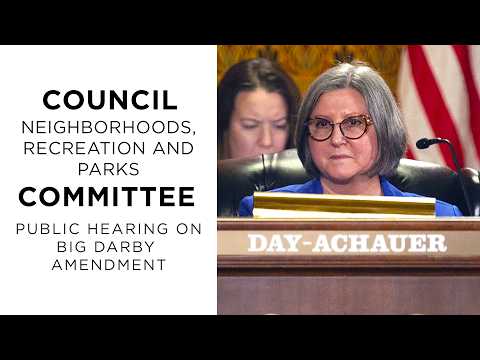
Columbus City Council held a public hearing on proposed amendments to the Big Darby Accord, a multi-jurisdictional framework for protecting the Big Darby Creek watershed, during which city planners and consultants outlined new mapping, larger stream buffers, a required annual water-quality monitoring program and a regional open-space acquisition fund. Supporters said the draft is substantially stronger than the 2006 Accord; conservation scientists and many residents urged the council to wait for the Ohio Department of Natural Resources' integrated prioritization system (IPS) phase 2 study before adopting final language.
Chris Herman of MKSK, the consultant team leading the update, told the council the amendment keeps the accord's 20,000 equivalent-residential-unit ceiling while expanding mapped conservation to about 30,000 acres and increasing protections for streams and wetlands. "We're going to spend 25% of those revenues on that purpose," Herman said, describing a regional open-space fund that would set aside a fixed share of development-related revenues for primary conservation areas. He also described new requirements for stream and wetland restoration, a 50% on-site open-space dedication for new development, limits on directly connected impervious area and a commitment to adaptive management supported by annual monitoring.
Deputy Director Brian Clark said the administration has sought broad stakeholder input and pledged to reconvene BART (the multi-jurisdictional Accord review panel) when ODNR's IPS phase 2 produces actionable results. Clark also told council the administration will seek capital funding, saying, "for our capital budget, we're going to be requesting $2 million for Darby open space acquisition." He announced Sustainable Columbus will provide staff support for implementing the Accord.
Supporters at the hearing — including representatives of Metro Parks, some township officials and the Accord advisory panel — described the update as a workable compromise that better protects sensitive areas while directing development toward urban edges. Tim Maloney, executive director of Metro Parks, said his agency has conserved thousands of acres and that earlier access to mitigation funds is essential: "The funding model is broken when the largest player in the game has received zero dollars," he said, urging that revenue be available earlier in project timelines so parks can acquire land before values rise.
But conservation scientists and many residents argued the IPS phase 2 study, due later this year, should inform the final Accord. The ODNR IPS is designed to link land-use scenarios to stream condition and to identify where additional development would push waterways past ecological thresholds. "I urge city council to wait for the completed ODNR IPS study," said Analise Roca of the Ohio Environmental Council Action Fund, adding that phase 2 will provide more precise thresholds for harm and help set limits the Accord should respect.
Speakers skeptical of immediate adoption raised several concrete concerns: whether new language's "may" versus "shall" phrasing would allow jurisdictions to avoid incorporating IPS findings; the timing of revenues (many prior Accord mechanisms were backloaded and uneven across jurisdictions); whether a permanent watershed coordinator should be created now or after the Accord is operational; and the risk that developments proceeding under the 2006 Accord could be built before new protections take effect.
City staff said the draft increases protections relative to the 2006 Accord and activates tools that were previously only advisory. The proposed buffer policy would require about 150-foot vegetated riparian buffers along streams, expanded no-build corridors around the main stems, prohibitions on impervious surfaces in near-stream zones, and restoration requirements for degraded ditches and wetlands. Staff emphasized that the draft requires developers to use modern BMPs and shifts much development to urban edges and central sanitary sewer connections rather than septic-based subdivisions.
Multiple public-comment speakers framed the choice plainly: proceed now under a more protective, enforceable draft that establishes monitoring and funding, or delay adoption to fold in IPS phase 2 but risk additional development occurring under the older 2006 rules. Mike Reeves, an advisory-panel member, noted applications continue to arrive at the panel: "Business is not slowing down in the city of Columbus," he said, arguing urgency to adopt stronger rules. Opponents responded that the IPS phase 2 could change the technical foundation of the Accord and that a short pause would avoid irreversible harms to the watershed's rare species and high biodiversity.
The hearing did not include a vote. City staff and council members closed by reiterating that the draft is explicitly designed to be an adaptive, living document: BART will meet regularly (at least quarterly) and the Accord text contains language for future revisions in light of new science and monitoring results. Staff also said ODNR and other state agencies were consulted during the drafting process.
Next steps for the proposal are legislative: Council will consider the draft amendment in subsequent meetings, and staff expect continued public input as jurisdictions proceed through their separate adoption processes. Proponents urged timely adoption to activate monitoring and early conservation funding; opponents asked the council to withhold final approval until ODNR's IPS phase 2 is available and fully reviewed by jurisdictions and the public.
The hearing record includes detailed technical presentations, a multi-hour public-comment period with both jurisdictional and resident testimony, and repeated commitments from staff to adapt the Accord as new data arrive. The Council has received written testimony and the public draft remains open for comment pending formal legislative consideration.