Get Full Government Meeting Transcripts, Videos, & Alerts Forever!
Get email alerts on the Energy topic
No spam. Unsubscribe anytime.
Planning commission approves 200 MW Winchester 3 solar project with safety and monitoring conditions
Summary
After extended public testimony on water, wildlife and battery‑safety risks, the Cochise County Planning and Zoning Commission unanimously approved SU26-04 permitting a 200 MW solar project with an 800 MWh battery system on ~1,250 acres west of Willcox, imposing conditions including an emergency response plan, baseline soil testing and wildlife protections.
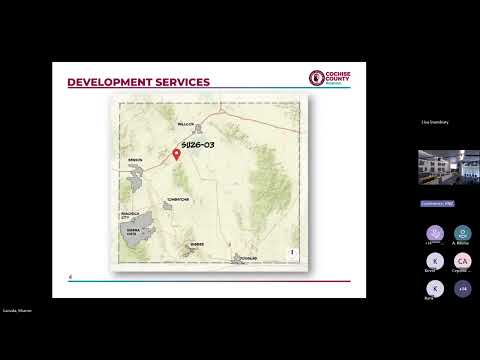
The Cochise County Planning and Zoning Commission voted to approve SU26-04, allowing the Winchester 3 solar energy project — a proposed 200‑megawatt photovoltaic facility paired with an 800‑megawatt‑hour battery energy storage system — on roughly 1,250 acres west of Willcox.
Torch Clean Energy representatives Scott Leech and Sarah Bourne told the commission the project has cleared key milestones in the utility interconnection process with Arizona G&T and is sited adjacent to Winchester 1 and 2. "We have passed that milestone, a really, really important aspect of the project," Leech said, and said the developer expects the project to generate substantial property tax revenue for the county.
Staff (Mr. Taylor) described the site as RU‑4 zoning within the Wilcox Active Management Area and said the application partially complies with the county’s special‑use factors when combined with conditions. Staff noted concerns raised in agency comments — especially from Arizona Game and Fish — about wildlife, and from other responders about dust during construction, visual impacts and emergency response for battery systems.
The public record for the docket was mixed. Sepand Alazada of the Arizona Technology Council urged approval, citing grid reliability and local economic benefits. Dozens of residents and experts spoke during the public comment period: supporters highlighted low water use, jobs and tax revenues; opponents raised concerns about water availability for construction dust control, property values, wildlife and the battery storage system. Christine Aerson, speaking online, argued the application lacked required manufacturer and safety documentation (UL9540A test reports, separation calculations and Tier II hazardous‑materials inventories) and urged denial or a continuance until documentation was provided.
In response, the applicant described safety steps for the battery systems: the use of lithium iron phosphate chemistry, UL9540 testing and NFPA standards, real‑time temperature and gas monitoring, deflagration panels and an emergency response plan coordinated with the Willcox Fire Department. Leech said such battery fires are rare: "Since this lithium iron phosphate technology came out, there's been two battery fires in the United States," and described automatic shutdown and monitoring systems the company will employ.
Commission discussion focused on emergency preparedness, panel and battery disposal and recycling, water for dust abatement during construction, road impacts and tax benefits. Staff recommended a set of conditions (read on the record) that include: a documented emergency management plan and subscription/ training agreement with responding fire entities; an updated traffic and dust‑control plan; minimum setbacks for arrays and battery facilities (including a 1,000‑foot buffer to existing residences for battery systems); preservation of wildlife corridors and post‑construction monitoring; and baseline soil testing with post‑construction follow‑up sampling (year 1 and every five years) to evaluate potential leaching to soil and groundwater.
The commission approved the special use request by roll call; commissioners recorded affirmative votes and the record notes appeal rights to the Board of Supervisors within 15 days. Implementation now proceeds through the county permitting process, where the project must demonstrate compliance with the conditions and provide the emergency response, decommissioning and monitoring plans required by staff.