Get Full Government Meeting Transcripts, Videos, & Alerts Forever!
Get email alerts on the Zoning Phase Two topic
No spam. Unsubscribe anytime.
OPCD outlines Phase Two zoning package to implement Seattle's Comprehensive Plan, citing SEPA review and displacement analysis
Summary
The Office of Planning and Community Development told the Select Committee on March 19 that Phase Two rezones would target neighborhood centers, expanded urban centers and frequent-transit corridors with mostly 5-6 story zones, changes to lowrise and midrise standards, mandatory housing affordability tiers, and that SEPA/EIS work covers the transmitted package but larger changes could require additional review.
The Office of Planning and Community Development on March 19 presented the Select Committee on the Comprehensive Plan with Phase Two zoning legislation intended to implement the Comprehensive Plan adopted in December and effective in January.
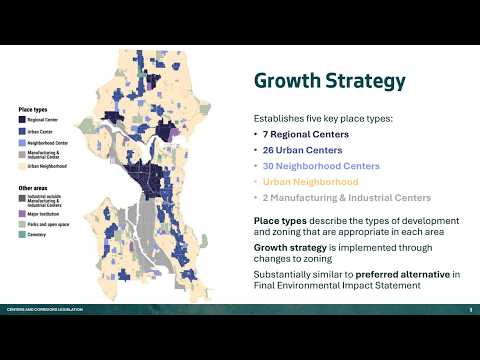
Michael Hubner, long-range planning manager, told the committee the Comprehensive Plan is a 20-year growth strategy required by the State Growth Management Act and that the Phase Two legislation translates the plan's place types into zoning. He said environmental review under the State Environmental Policy Act (SEPA) covered the transmitted preferred alternative and that changes that substantially increase the area or intensity of growth would likely require supplemental environmental review.
Brennon Staley, who leads the zoning changes, described the proposal's scope: rezoning parcels inside 30 new neighborhood centers, expanded urban centers and parcels immediately adjacent (generally one lot deep) to frequent-transit corridors, with many blocks proposed for five- and six-story apartment or condominium zoning to make multifamily development feasible. Staley said some four-story zones would remain at center edges or on steep slopes.
The proposal also revises development standards across multifamily zones. Key changes include a stacked-flat bonus in lowrise zones (to align with recent neighborhood-residential changes), allowing five stories in LR3 outside centers, raising LR3 FAR to 2.5, and creating a new six-story midrise zone (midrise 1) while simplifying midrise setbacks, maximum width and depth requirements. Project-level Mandatory Housing Affordability (MHA) requirements would apply to rezoned properties, with higher MHA tiers for larger upzoning (M, M1, M2 suffixes depending on degree of change).
Staley said the team reviewed more than 9,000 public comments and adjusted the October 2024 draft to reflect local conditions such as topography, environmentally critical areas, historic boulevards and split-zone lots; the proposal increases the number of split-zone lots addressed near centers to make redevelopment more practicable.
On displacement, OPCD said it prepared a memo for council that finds the legislation would increase housing supply and generate more affordable homes through MHA and the multifamily tax exemption than the number of rental units expected to be lost to redevelopment, though the proposal would result in additional demolition of detached homes. Hubner and Staley said a small share of rezoned parcels are in higher-risk displacement areas and that the package aims to concentrate capacity in lower-risk areas while funding affordability through MHA.
Council members asked for additional graphics and neighborhood-specific visuals to show FAR, height and setback differences, and asked OPCD to provide PDF maps for outreach. OPCD said it would prepare additional slides and that staff are available to appear at neighborhood meetings to explain details. The committee was also told that state law changes such as House Bill 1491 (transit-oriented provisions) were informing the city's work program.
The committee scheduled a public hearing on the legislation for April 6, 2026.