Get Full Government Meeting Transcripts, Videos, & Alerts Forever!
Get email alerts on the School Closures topic
No spam. Unsubscribe anytime.
Vallejo trustees review equity analysis that recommends closing three elementary schools
Summary
At a Sept. 24 study session, Vallejo City Unified staff and consultants presented a draft Equity Impact Analysis and recommended closing Lincoln, Cooper and Penny Cook, with relocation options for the John Finny Education Complex. Trustees pressed for more data on transportation, program continuity, costs and community impacts ahead of a Dec. 17 decision deadline.
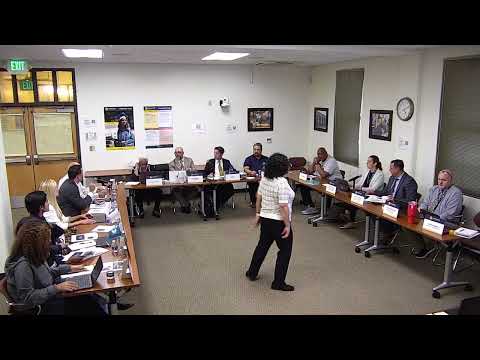
VALLEJO — The Vallejo City Unified School District held a special study session on Sept. 24 to review a draft Equity Impact Analysis (EIA) tied to a proposed second phase of school closures and consolidations.
The superintendent opened the session by framing the meeting as informational, saying the district is “continuing to deficit spend” and that closing or consolidating schools is one part of a larger effort to right-size the district’s finances and facilities. The superintendent said staff were presenting preliminary recommendations that would anchor board discussion but were not final decisions.
The consultants who prepared the EIA summarized a color-coded analysis of potential equity impacts for 16 receiving-school options. Their presentation flagged transportation, special-program capacity and adult-to-student staffing ratios as recurring concerns: some site pairings showed negligible impacts, while others — notably scenarios that would split grade spans or move high numbers of students to sites with constrained special‑education capacity — were rated medium or high impact.
Staff recommendations and savings estimates
District staff said their preliminary recommendations were to close Lincoln Elementary, Cooper Elementary and Penny Cook, and to relocate the five programs currently housed at the John Finny Education Complex if Cooper were closed. The superintendent said the proposed closures are intended to reduce operating expenditures and align facility capacity with a district that once was sized for more than 20,000 students but now serves under 10,000.
Staff and trustees discussed estimated annual savings tied to specific scenarios. Assistant staff and trustees referenced the following approximate figures presented during the session: Lincoln (roughly $300,000), Cooper (about $450,000), Federal Terrace (about $400,000 in one scenario), and Highland (about $650,000). The superintendent cautioned that capital dollars can pay for parking or temporary structures but not salaries or other general operating costs.
Trustee and community concerns
Multiple trustees raised community-impact concerns about Lincoln, which sits in the downtown area and hosts wraparound services such as a community pantry and other supports. Trustee Flores said closing Lincoln would risk removing an important neighborhood resource for vulnerable families and urged that any closure plan protect those services. A fellow trustee noted Lincoln’s historical role in the downtown neighborhood and stressed that the district should explore reuse options that preserve local supports if the site is vacated.
Trustees also pushed staff for clearer information on transportation impacts, capacity constraints, and the cost of mitigation measures (such as added busing, portables, new parking, or staggered schedules). Consultants and staff said some scenarios would trigger an attendance boundary review and potentially require redrawing maps districtwide to distribute students equitably.
Special programs and continuity
Trustees asked specifically about the Deaf and Hard of Hearing (DHH) program at Penny Cook; staff said the program would continue but would need a new host campus if Penny Cook were closed, and that students in that program are typically transported by the district. Staff emphasized that specialized programs require smaller classrooms and different space calculations than general‑education classrooms.
Logistics, facilities and reuse options
Board members and staff discussed site-specific constraints such as limited multi-purpose dining space at Penny Cook (which limits indoor lunch capacity on rainy days), parking and egress difficulties at Highland, and the potential for Cooper to absorb some programs if boundaries and capacity allow. The John Finny Education Complex — formerly Vallejo Middle School — was discussed as a flexible asset that could be repurposed in several ways, including workforce housing, a future middle school site, or district office space; staff cautioned that market conditions and bond‑dollar restrictions would shape what is feasible.
Process, next steps and timeline
The superintendent asked trustees to provide guidance on the number of closures the board is prepared to consider. Trustees requested follow-up data — dollar figures for transportation and mitigation, detailed capacity analyses for receiving campuses, and clarifications on program relocation logistics. Staff said the final EIA would be completed and returned for board consideration in mid-November, with a board decision on closures targeted for Dec. 17. Until that formal action, the meeting remained a study session with no votes taken on closures.
What trustees did vote on
The only formal action recorded during the Sept. 24 meeting was a procedural vote to adopt the meeting agenda. Vice President Amboy moved the motion and the roll call showed a 4–0 vote with one member absent.
Why it matters
School closures and consolidations affect students’ daily travel, the availability of special programs, neighborhood access to school-based supports, and district finances. Trustees repeatedly framed the choices as difficult tradeoffs between fiscal sustainability and protecting community resources. Multiple trustees urged staff to prioritize options that maintain services to the district’s most vulnerable students and to provide clear, site-specific cost estimates before any final decisions.
Board members and staff agreed on an iterative path forward: trustees will submit specific questions to the superintendent’s office ahead of the Oct. 15 study session; staff will compile requested data and, where appropriate, work with the consultants to integrate targeted analyses into the final EIA ahead of the November presentation and a December decision deadline.