Get Full Government Meeting Transcripts, Videos, & Alerts Forever!
Get email alerts on the School Infrastructure topic
No spam. Unsubscribe anytime.
RSU 40 wins nearly $4 million in state aid; Medomak Valley High bond pared to $24.9 million
Summary
RSU 40 (MSAD 40) received almost $4 million from the state Revolving Renovation Fund to cover Union Elementary ventilation and Medomak Valley High asbestos and water work, enabling the district to trim a proposed high school bond to about $24.9 million; board members pressed for final scope details and raised special-education placement concerns ahead of a March vote.
RSU 40 officials told the school board they secured nearly $4 million from the State Department of EducationRevolving Renovation Fund, allowing the district to remove roughly $2 million in state-funded items from a proposed Medomak Valley High School bond and reduce the estimated project total to about $24.9 million.
"We were very lucky that the asbestos and the water quantity did get funded through the state," said Carrie Worms of Energy Efficiency Investments, one of the project presenters. She said the district's water-quality application ranked second among roughly 120 submissions and that the program forgives about 43% of a project's cost while financing the remainder at 0% for 10 years.
The funding package covers three projects totaling about $4 million: approximately $2 million for Union Elementary School ventilation and just under $2 million for asbestos abatement and water-quality improvements at Medomak Valley High School. That state support, Worms said, "helped us get more into the high school project" by removing mandatory baseline items from the bond ask.
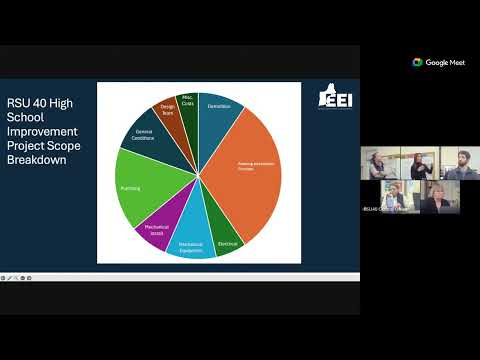
Designers and administrators presented a narrowed scope for the high school intended to bring the 1960s-era building to a safe, operational baseline without adding new square footage. Planned work includes replacement of failing unit ventilators with a ducted ERV ventilation system, a new secure entry vestibule, a buildingwide sprinkler system triggered by the renovation thresholds, science-lab upgrades, asbestos abatement, ceiling and finish repairs, updated building controls, plumbing and underground water-piping work, and accessibility improvements.
Nobel Studio Architects estimated the comprehensive scope at about $27.8 million. After removing selected itemsincluding a lighter locker-room renovation (about $1.2 million in reductions), switching to less-costly flooring, and subtracting the state-funded asbestos and water workthe team brought the bond estimate to approximately $24.9 million.
The presenters emphasized a phased approach: much of the work would be completed over successive summers through 2028 so classrooms remain usable during the school year. "We're going to be doing a lot of it over the next three summers starting with the asbestos and water this summer," the design team told the board.
Board members asked for more detail on design choices and budget certainty. Rachel Morrison asked whether changes to conceptual plans could shift overall costs; the team said most items are budgeted to fit within the $24.9 million figure and typical contingency ranges are about plus-or-minus 15 percent during final pricing. The locker-room redesign remains the principal pending change.
Several board members and community members raised concerns about special-education space shown in earlier conceptual plans. Lynn said those plans were placeholders and stressed that special-education placements are not finalized. "I'm very aware of the needs of my building and I'm very aware of people's concerns for segregation; those are simply placeholders right now to figure out costs," she said.
Architect Ann Catterall said she relies on special-education staff for placement decisions and did not intend to consolidate services in a manner that would isolate students. "I don't decide where special education goes. I listen to the experts," she said.
Next steps: the design team and administration will refine room layouts and cost lines over the coming weeks, returning to the board with revised plans before a planned vote on the bond in March. No formal motion or vote on the bond was recorded at this meeting.