Get Full Government Meeting Transcripts, Videos, & Alerts Forever!
Get email alerts on the Mine Action topic
No spam. Unsubscribe anytime.
UN Mine Action Service warns explosive remnants are slowing recovery, urges donors to back tech and clearance
Summary
UN Mine Action Service officials told reporters that explosive remnants of war in Afghanistan, Ukraine and other conflicts are causing civilian casualties, blocking recovery and require urgent funding and investment in technology; UNMAS detailed country needs and pilot costs.
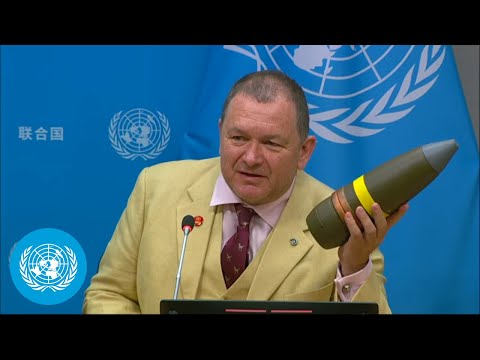
United Nations Mine Action Service officials on a press briefing said explosive remnants of war are blocking recovery and costing lives, and urged increased donor funding and investment in new technologies to speed clearance.
Kazumi Ogawa, the newly appointed director of the UN Mine Action Service, opened the briefing by saying the service’s work "is driven by the needs of the community" and that mine action "saves lives, protects civilians, enables peacekeepers to operate in safety and facilitates the delivery of humanitarian aid." She noted UNMAS also advocates for international humanitarian and human-rights law and supports national authorities to build local capacity.
Nick Pond, chief of the Mine Action Section in the United Nations Assistance Mission in Afghanistan, said Afghanistan has "the third highest explosive-ordnance casualty rate in the world, with around 50 people killed or injured every month," and that nearly 80% of those casualties are children. He described a Feb. 12 incident in Nangarhar in which two boys were killed and several others wounded. Pond said "there are over 1,000 square kilometers of land known to be contaminated" in Afghanistan, that "almost 3 million people" and hundreds of education and health facilities sit within 1 km of contamination, and that the sector is underfunded after deminer numbers fell from about 15,000 in 2011 to roughly 1,300 this month.
Pond said Afghanistan submitted a five-year clearance plan under the Anti-Personnel Mine Ban Convention requesting "just over $250 million" to conduct clearance in accordance with that plan.
Paul Heslop, UNMAS special adviser to the resident coordinator in Ukraine, described the problem’s global scale and economic impact. Heslop said unexploded ordnance in Ukraine contributes to an estimated $11 billion annual impact to the Ukrainian economy and a 3–5% reduction in GDP growth, and warned modern conflicts (he cited Ukraine, Gaza, Sudan and Iran) will leave long-term contamination unless cleared.
Heslop highlighted emerging technologies that UNMAS is piloting or using: satellite and drone imagery analyzed with AI, new sensors and robotic systems, and remotely deployed monitoring. He said one UN assessment "used satellite imagery, drone imagery with AI and human data analytics" to assess more than 30,000 square kilometers and — in his characterization — return land at a reported cost of "around $100,000." He added that pilot projects to provide proven drone-monitoring capability for teams would cost about $1–2 million, with scale deployment around $10 million, while noting Ukraine’s mine-action program is roughly $300 million per year.
On sea mines, Heslop cautioned that maritime clearance is far more complex than land clearance — involving depth, tides and three-dimensional search challenges — and typically requires state and naval capacity; he said straits such as Hormuz pose particular humanitarian risks.
When asked about recent media reports that the United States may have dropped anti-tank mines in Iran, Heslop said UNMAS had not seen verified reports and that the service has no program or personnel on the ground in Iran; he noted the use of drone-delivered mines in Ukraine and cautioned that indiscriminate delivery into civilian areas carries serious legal and humanitarian consequences.
Kazumi Ogawa described UNMAS’s funding situation: the service raised about $74.9 million last year but lacks flexible, unearmarked funds that enable innovation and bridge projects when earmarked money ends. She said UNMAS had conducted more than 1,000 explosive-ordnance assessments in 2025 and trained nearly 2,000 deminers in 2025, and flagged outreach plans for World Mine Action Day, including an online film festival and the search for a global advocate.
The briefing closed with a call for sustained donor support and for the international community to invest in both clearance capacity and victim assistance. The panel included Ogawa, Heslop and Pond; the session concluded with a short closing announcement from the moderator.