Get Full Government Meeting Transcripts, Videos, & Alerts Forever!
Get email alerts on the Budget Requests topic
No spam. Unsubscribe anytime.
House subcommittee hears score of one‑time funding requests for homelessness, housing, health and workforce programs
Summary
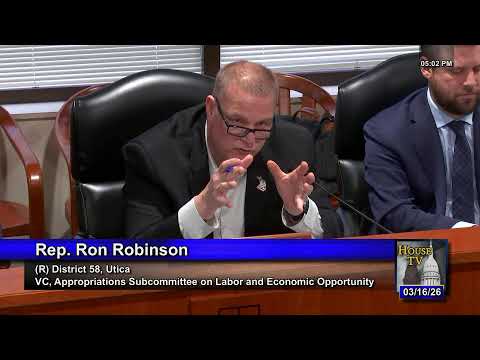
The House Appropriations Subcommittee on Labor and Economic Opportunity heard presentations on a wide range of one‑time LDSI funding requests from community groups asking for support for parks, home repairs, food access, recovery programs, mental‑health crisis care, violence‑interruption and workforce training. Lawmakers pressed presenters on budgets, sustainability and other funding sources; no formal votes were held.
LANSING — Lawmakers on the House Appropriations Subcommittee on Labor and Economic Opportunity heard more than two dozen funding pitches from community groups on March 17, as nonprofit leaders asked the panel to include one‑time appropriations in the 2026‑27 budget.
The requests ranged from $500,000 to refurbish Orchard Park in Battle Creek to a $3 million ask to complete crisis residential units at a mental‑health center in northern Michigan. Presenters described projects that would pay for physical upgrades — grading, court resurfacing, new refrigeration and cold storage — as well as service expansions such as 12‑month residential recovery programs, expanded sexual assault nurse examiner coverage and a violence‑interruption fellowship.
Rep. Jenkins Arno opened the meeting by confirming a quorum and approving the minutes from the March 11 session. The committee then moved through a packed agenda of Legislative DHS Initiative (LDSI) requests and partner presentations.
Bishop Dr. Tino Smith, founder of Kingdom International, asked for $500,000 to “revitalize and redevelop Orchard Park” in Bedford Township with site grading, a resurfaced basketball court, a walking path and safety enhancements. Smith said the project would include a locally registered ‘‘Menshed’’ program to provide mentorship and work opportunities and estimated the effort would directly impact roughly 500 residents in the neighborhood if funded.
Reverend Dr. Mon'nique French, pastor and director at Washington Heights United Methodist Church, outlined a $750,000 ask for a Healthy Homes and Homeownership Stabilization program that she said would stabilize 35–60 homes with work such as roof and HVAC repairs, electrical and plumbing remediation and energy‑efficiency upgrades. Dr. French also described a separate $350,000 request to upgrade WHMC’s cold storage and distribution for a winter food program, telling the committee $150,000 of that request would pay for food and $60,000 for refrigeration equipment.
Several presenters emphasized sustainability and matching funds. Amanda Collins, program coordinator at Haven of Rest Ministries, said a $600,000 request would help professionalize clinical supervision and training for long‑running men’s and women’s recovery programs that currently serve 80–100 people per year. “We’re looking to get Medicaid reimbursement to continue,” Collins said when asked about long‑term funding.
Public safety and violence prevention were prominent topics. Michigan Public Health Institute leaders described the Advanced Peace Peacemaker Fellowship in Lansing, a community violence intervention model that recruits “credible messengers” to mentor and mediate with people at high risk of retaliatory violence. Presenters pointed to an independent evaluation that associated the program with a reduction in shootings in targeted neighborhoods.
Mental‑health capacity in northern Michigan also drew attention. Mson Healthcare officials described the Grand Traverse Crisis and Access Center, opened in January 2025, and requested $3 million to add nine adult and six pediatric crisis‑residential beds — short‑term, non‑locked stays intended to avert hospitalization.
On broader system stability, the Michigan Primary Care Association asked lawmakers for $38 million to offset projected shortfalls at federally qualified health centers statewide. MPCA warned that federal policy changes could increase the number of uninsured patients and reduce service reimbursements, potentially forcing service reductions without state help.
Several presenters stressed that their projects were already leveraging other public and private funds, or would seek federal grants, foundation dollars and local support if the LDSIs were not approved. Questions from committee members repeatedly pressed for details about: whether projects had matching funds; precise use of requested dollars; program capacity and projected numbers served; and paths to long‑term sustainability.
The subcommittee heard a final set of requests covering immigrant and tribal needs, cultural infrastructure, and youth sports and mentoring programs. Autism Alliance of Michigan told the panel cuts to its state grant had slowed service capacity by roughly 75% since October and asked for restoration to its prior funding level to maintain a licensed, master‑level statewide navigator program that handles 3,500–4,000 cases a year.
The meeting ended without votes; lawmakers said they would consider the portfolio of requests as the budget process continues.