Get Full Government Meeting Transcripts, Videos, & Alerts Forever!
Get email alerts on the Advisory Boards topic
No spam. Unsubscribe anytime.
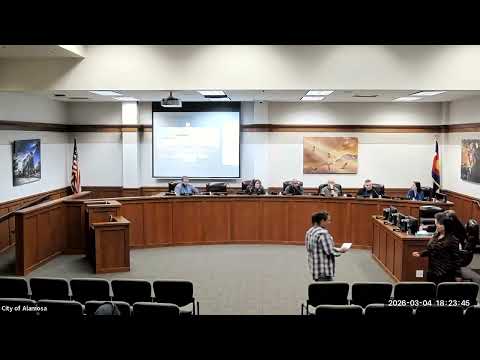
Alamosa council debates widening advisory-board eligibility; decides not to change rules now
Summary
Councilors discussed proposing a charter amendment to allow Alamosa County or San Luis Valley residents to serve on city advisory boards without the current dual residency/work/property requirement; councilors aired legal and optics concerns and left current rules unchanged pending further study and public input.
The Alamosa City Council spent a work-session block considering whether to ask voters to change the city charter so more people could serve on advisory boards.
Councilors weighed proposals that would either expand eligibility from city residents to all Alamosa County residents or to the wider San Luis Valley, and discussed whether to change the existing requirement that county residents also demonstrate a business, property or full-time-work nexus inside city limits. Staff reminded the council that any change to those rules requires a charter amendment and a municipal vote.
The discussion focused on two questions: how far geographically to expand eligibility, and whether the current "and" test (you must live in Alamosa County and also own property, own a business, or work full-time in the city) should become an "or" test (meet either the geographic or the nexus requirement). Councilors who favored retaining the status quo said the current language protects the city’s interests and avoids potential outside agendas; councilors open to expansion argued it could bring valuable volunteers—including youth—who now are excluded.
"We took it to the voters because it is in the charter," staff said in the session, noting that any change would require ballot language and outreach if council wants it on this year’s ballot. Councilors agreed staff should prepare options and said they preferred to consider components—geography first, then nexus—rather than attempt multiple changes at once.
Several councilors flagged two practical concerns. First, they said, expanding eligibility could create optics problems if city applicants lose out to nonresident appointees. "If people that apply from the city of Alamosa are like, 'We applied, but you chose this person from Monte Vista,' the city council is going against the people they represent," one councilor said. Second, some councilors worried that applicants from other places might bring outside political agendas to local boards.
On legal risk, staff and councilors noted that widening the applicant pool would not change the city's obligations under anti-discrimination law: suits alleging unlawful discrimination still must show adverse treatment tied to a protected class. A councilor also cited a current lawsuit in Boulder involving board removal and alleged First Amendment and due-process claims to illustrate that litigation can arise for reasons other than protected-class discrimination.
Councilors discussed practical middle-ground options: expand eligibility to the county but keep the nexus test; expand to the entire San Luis Valley but require a demonstrable tie to the city (for example, a business address inside Alamosa); or change the "and" to an "or" so county residents qualify without also demonstrating nexus. Some said the city could refine the application and interview questions to probe applicants’ motives and ties.
Rebecca, a resident who identified herself during public comment, urged the council to broaden eligibility. "A lot of people that I've actually met come from the San Luis area and they come here for the help," she said, arguing those residents could contribute.
The mayor thanked councilors for a "healthy debate" and indicated the council would "leave things like they are" for now; no motion or charter referral was adopted at the work session. Staff said council could request draft ballot language and education materials if it later decides to put the question to voters. The council recessed the work session and invited additional public comment at the regular 7:00 p.m. meeting.
What happens next: staff can prepare draft charter language and outreach if the council votes to pursue a ballot measure; otherwise the current eligibility requirements remain in force.