Get Full Government Meeting Transcripts, Videos, & Alerts Forever!
Get email alerts on the Administration topic
No spam. Unsubscribe anytime.
Sacramento LAFCO to study breaking away from county personnel/administration; commissioners request detailed cost and timeline
Summary
LAFCO staff presented options for making the commission an independent employer rather than relying on Sacramento County for personnel, payroll and administrative services. Commissioners urged further analysis of costs, contracts, technology support and transition impacts and directed staff to return with a detailed plan.
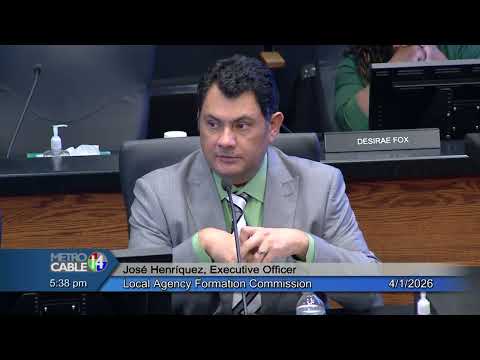
At the April 1 meeting Sacramento LAFCO’s Executive Officer summarized work by the Personnel Ad Hoc Committee on whether the commission should separate from Sacramento County for personnel and administrative services. The EO explained LAFCO’s current arrangement outsources hiring, payroll, accounts payable and other administrative functions to the county; this can limit the commission’s flexibility on classifications, compensation and reporting detail.
The EO described three general models used by other LAFCOs: (1) fully county‑integrated (LAFCO is essentially a county department), (2) fully independent (LAFCO is its own employer and accounting entity), and (3) hybrid partnerships (current model for Sacramento) where some functions are handled by county partners.
Staff presented a draft costing that suggested independence would not necessarily cost materially more overall but would change how costs are accounted and would provide intangible benefits: the ability to set classifications, compensation levels and staffing size that match LAFCO’s needs; clearer expenditure categories for budget visibility; and more direct control over hiring and classification ladders. The EO cautioned that becoming independent would likely require existing staff who wished to remain with LAFCO to resign county jobs and forgo union representation in the county system; meeting and technical support (chambers, livestream, clerk services) could be contractually retained from county providers.
Commissioners generally supported continuing the study. They asked staff to return with a more detailed, line‑item cost comparison, a timeline for transition, procurement/contracting options for meeting and technology support, and the operational implications for existing staff and union/benefit coverage. Several commissioners emphasized that the county relationship has worked in many respects and thanked county partners, but said LAFCO’s small size makes nimbleness important.
Next steps The commission directed staff to proceed with further analysis of separation logistics, costs and timelines and to return with a more detailed plan for commissioner consideration.