Get Full Government Meeting Transcripts, Videos, & Alerts Forever!
Get email alerts on the Medicaid Budget topic
No spam. Unsubscribe anytime.
Legislative fiscal staff warns DPHHS shortfall driven by state hospital costs and Medicaid growth as providers plead to protect rate increases
Summary
Legislative fiscal staff told the finance committee that a proposed DPHHS supplemental transfer is driven by higher-than-budgeted state hospital costs and Medicaid spending; dozens of providers urged lawmakers not to cut optional benefits or freeze provider rate increases, warning it would reduce access and shift costs to hospitals.
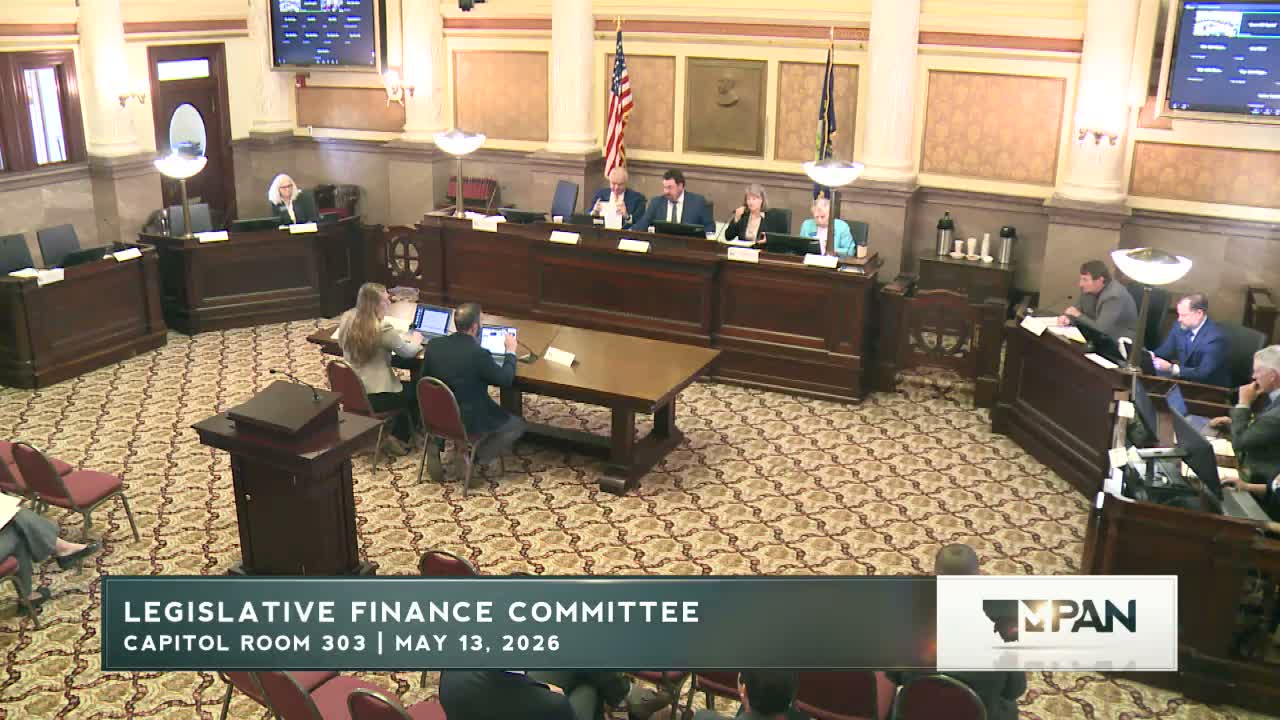
Legislative fiscal staff told the Legislative Finance Committee on May 6 that a proposed supplemental appropriation and inter‑year transfer for the Department of Public Health and Human Services (DPHHS) is driven primarily by higher operating costs at state psychiatric facilities and by Medicaid spending that outpaces current appropriations.
Josh Platt, fiscal division, said the executive requested transfers that would move authority from the second fiscal year into the first: “$7,000,000 general fund, $34,200,000 state special, and $146,300,000 from the second fiscal year to the first fiscal year,” and that two principal drivers are state‑operated facility costs and Medicaid program growth. Platt and his colleagues presented charts showing volatile post‑public‑health‑emergency Medicaid enrollment and higher provider rate adjustments passed in prior sessions.
Julie Hamilton, fiscal staff, told the committee Medicaid enrollment redeterminations and large provider rate changes in 2023 contributed to uncertainty in per‑member costs. “We saw very large growth in enrollment during the public health emergency and then a very drastic decline at redetermination,” Hamilton said, noting that caseload and per‑member‑per‑month costs may not have been accurately estimated during the volatile period.
Fiscal staff also highlighted a projected reduction in the federal Medicaid match (FMAP). Platt said FMAP dropped from about 61.47% to roughly 60.01, increasing pressure on the state general fund and contributing to an estimated $40–50 million supplemental need in FY2027 if no further mitigation measures are adopted.
Julie Johnson, legislative staff attorney, reviewed the statutory process for a fiscal‑year transfer and reminded members that statute requires both that the shortfall be unforeseen or emergent and that the agency present a plan to reduce second‑year expenditures. Johnson cautioned that the mitigation measures submitted by DPHHS to date “may not fully mitigate the need for a supplemental in fiscal year 2027.”
DPHHS deputy Medicaid director Jean Hermanson described constraints on cutting optional benefits. “There are a lot of constraints around our ability to do that, both on state and federal level,” Hermanson said, noting that changes to waivered benefits or benefit packages typically require lengthy federal approval and are unlikely to produce material FY27 savings.
Public comment was extensive. Emily Herndon, president of the American Physical Therapy Association of Montana, said physical therapy is classified as optional at the federal level but argued that “optional is a federal classification and not a clinical reality,” warning that cutting services shifts costs to emergency rooms and nursing homes. Ann Geiger of Aware described how underfunded provider rates shrink capacity and increase pressure on crisis and institutional care. Several behavioral health groups, pediatricians, disability advocates and unions urged the committee to protect the 3% provider rate increase approved in 2025 and to pursue alternative funding rather than service reductions.
Committee members pressed staff for follow‑up data, including how many and which providers would be affected if the FY27 provider increases were not implemented and whether rural providers would be disproportionately harmed. Fiscal staff and the governor’s budget office offered to provide additional detail for the committee’s consideration.
The committee took no formal final action on the supplemental request during the meeting; staff outlined options for an LFC report to the governor on statutory compliance and mitigation recommendations.