Get Full Government Meeting Transcripts, Videos, & Alerts Forever!
Get email alerts on the Homelessness topic
No spam. Unsubscribe anytime.
Pastor Kevin Riggs presents "Stable House" transitional housing plan for city-owned water parcel
Summary
The Williamson County Homeless Alliance proposed building an 11,000 sq ft transitional facility and eight small homes on a roughly 3–4 acre city-owned water-utility parcel at 113 Old Carters Creek Pike. The board asked staff to vet site constraints, need and financing; no final action was taken.
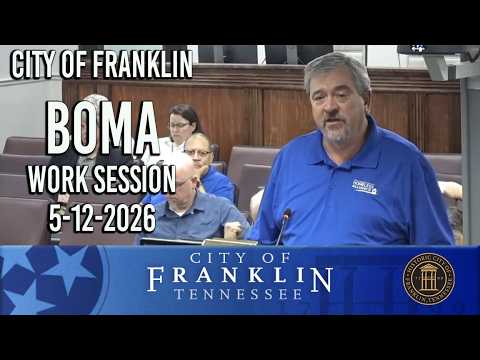
Kevin Riggs, pastor of Franklin Community Church and executive director of the Winston County Homeless Alliance, asked the Board of Mayor and Aldermen on May 12 to let his group and city staff study a proposal to build a transitional housing campus on about 3–4 acres the city owns at 113 Old Carters Creek Pike.
The proposal calls for an approximately 11,000-square-foot main building with a multipurpose room, commercial kitchen, laundry, case‑management offices and separate wings for men and women, plus eight small, roughly 600-square-foot homes intended for longer-term transitional stays. Project materials in the board packet list community partners — including Habitat for Humanity, the transit authority and the county health department — and about eight letters of support. Riggs said the alliance has moved “a little over 200 families from homelessness into housing,” citing the group’s recent HUD-funded placements and case-management work.
The presentation emphasized services and privacy: the main building would offer 66 transitional beds, family rooms with private restrooms and a playground and a school‑bus turnaround to keep children connected to their schools. The applicant said the campus would be pet friendly and include a dog park and kenneling options because many shelter users keep animals.
Board members welcomed the concept but pressed for detail on need, cost, neighborhood impacts and city obligations. Vice Mayor Baggett said he wanted neighbors “brought along” and asked how the city could establish an empirical baseline for demand rather than building capacity without clear need. He noted staff should study parking impacts and how many people in the city limits need the service today. Alderman Burger urged careful vetting of safety and eligibility procedures; Alderman Blanton criticized any design elements that felt punitive, saying at one point, “I can't support that … it's robbing dignity right there right out of the gate,” in reference to stainless‑steel lavatory details discussed for cleanliness but perceived by some as prison‑like.
City staff reiterated that the presentation was intended to gather board guidance on whether staff should spend additional time evaluating zoning, utilities and other constraints. Staff also noted preliminary analyses of topography and adjacent landowners; several aldermen asked staff to confirm whether other city needs exist for the property and for more detail about demolition or remediation costs tied to the site’s prior water‑utility use.
No formal motion or vote occurred. Multiple board members said they were open to continuing the conversation but wanted a structured vetting process that addresses demand estimates, funding sources and infrastructure challenges before the board considers any conveyance or support.
The board requested staff follow up with more detailed site information, estimated costs and coordination with county partners and return with specific recommendations for next steps.