Get Full Government Meeting Transcripts, Videos, & Alerts Forever!
Get email alerts on the Urban Forestry topic
No spam. Unsubscribe anytime.
Council committee hears bill to update Baltimore’s forest conservation code; vote postponed for law‑department amendments
Summary
The City Council committee received agency reports and a Planning presentation on Bill 26‑00161 to align Baltimore’s forest and tree conservation code with recent state requirements; members raised questions about notice, appeals and equity, and the committee postponed a vote pending law‑department amendments and an updated finance report.
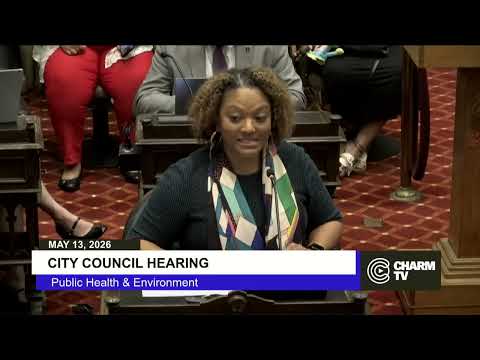
The Baltimore City Council’s Public Health and Environment Committee heard a multi‑agency briefing on Bill 26‑00161, which would revise Article 7 of the City Code to conform to state forest conservation requirements and to set a new effective date in response to recent state legislation. The committee did not vote on the bill; Chair Felicia Porter said the Law Department’s amendments and an updated Finance report are pending and the committee will reconvene in roughly two weeks to finalize action.
Planning Department staff (Amy Gilder Bassotti, Office of Sustainability) outlined state context, timeline and the bill’s major changes. She said the legislation responds to 2023–2024 state action (presented in the hearing as "Senate Bill 526" and "House Bill 723") that shifted state policy toward no‑net‑loss and increased emphasis on urban canopy goals and set July 1, 2026 as an effective date for local program changes. "The state allows local jurisdictions to customize local programs to what works for local jurisdictions and their conditions," the presenter said, adding that DNR has mapped urban forested areas now counted as priority retention.
Key bill elements presented by Planning include: updating definitions (including urban forest mapping and 'priority retention' categories), new public notice and comment requirements when projects propose to clear priority retention areas (with both written and verbal comment required for large‑scale clearing), a shift to percentage‑based afforestation thresholds (the city recommends maintaining a 15% tree canopy requirement for certain land uses to address equity), and additional mitigation tools (restoration of degraded forest, off‑site easements, mitigation banks) as alternatives before fee‑in‑lieu payments.
Agency reports and fiscal considerations: the Law Department reported nine amendment points and said two technical issues (standards for clearing priority retention and judicial review language) remain under discussion. The Finance Department said it could not complete a bill report because substantive amendments are pending and noted the bill could impose additional costs on private development while offering more flexibility; Finance agreed to supply an updated report before a vote. Recreation and Parks and DHCD provided supportive or standing reports.
Council questions focused on appeals and notice, equity and scope. Councilwoman Odette Ramos urged inclusion of an administrative review step in addition to judicial review because the 30‑day window for filing petitions is impractical for many residents; Planning said language is being drafted to incorporate appropriate administrative appeal timing. Ramos also recounted a case in her district where residents felt they had inadequate notice about trees being removed and pressed for stronger notice and review triggers; Planning clarified the bill covers parcel and forest protections and that street and park trees fall under Rec & Parks authority.
Councilman Mark Parker asked what kinds of projects would be affected; Planning and Forestry staff said the bill would affect larger projects (stream restorations, large utility clearings) and privately held forested parcels being subdivided for development. Matt Rescott (Rec & Parks, Forestry) listed active and planned stream restoration projects the department is overseeing.
Public testimony: a virtual commenter urged protections that account for hydrology impacts beyond parcel boundaries, measures to hold developers liable for impacts to forest conservation easements, environmental studies before permitting, and funds or mechanisms to ensure replanting success and long‑term maintenance.
Next steps: the committee postponed a vote until Law Department amendments are finalized and Finance submits an updated bill report; Chair Porter said the committee intends to complete the work in time to meet the state's July 1 deadline for local code updates.