Get Full Government Meeting Transcripts, Videos, & Alerts Forever!
Get email alerts on the Health Information topic
No spam. Unsubscribe anytime.
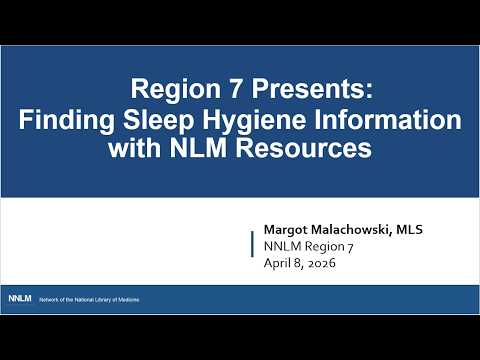
Margot Malachowski demonstrates how to find sleep‑hygiene information across NLM resources
Summary
In an April 8, 2026 Region 7 webinar, Margot Malachowski (NNLM Region 7) walked attendees through MedlinePlus, PubMed, MeSH and ClinicalTrials.gov to locate patient-facing information, research articles and trial results on sleep hygiene and related topics.
Margot Malachowski, Education and Outreach Coordinator for the Network of the National Library of Medicine (NNLM) in Region 7, led a webinar on April 8, 2026 demonstrating how to find consumer and research information about sleep hygiene using National Library of Medicine (NLM) resources.
Malachowski began with MedlinePlus.gov, describing its health-topics layout and consumer focus. She showed the "healthy sleep" (sleep hygiene) topic page, pointed to NIH and trusted external links, and highlighted language-access features including an Español page and additional language PDFs. "Sleep affects our cardiovascular health, our metabolic regulation, immune function, mental health, workplace safety, and learning," Malachowski said, framing why accessible consumer resources matter.
She then moved to PubMed, contrasting three searches to illustrate scope: (1) the MedlinePlus-forwarded PubMed query returned 10 results with filters applied; (2) a simple keyword search for "sleep hygiene" returned more than 10,000 results; and (3) a PubMed search restricted to the MeSH major topic "sleep hygiene" plus "patient education" narrowed results to 27. Malachowski explained that using controlled vocabulary (MeSH) makes literature searches more precise and demonstrated how MeSH terms "explode" to include narrower concepts such as sleep quality and sleep latency.
The session included a walkthrough of the MeSH record pages for terms including "sleep," "sleep‑wake transition disorders," "circadian rhythm," and "sleep hygiene," and a demonstration of sending MeSH terms to PubMed to refine queries. Malachowski noted that MeSH terms are revised annually and that NLM uses automated tools to help assign indexing terms, underscoring why authors should place key terms in titles and abstracts.
Finally, Malachowski reviewed ClinicalTrials.gov search features and record pages. She emphasized that ClinicalTrials.gov is maintained by NLM but that responsibility for the safety, science and accuracy of trial entries rests with the study sponsor or investigator, stating that "the US government does not review or approve the safety and science of all studies listed on this website." Using filters for study status and "results posted," she showed two trial records with posted results (examples sponsored by Black Hills State University and Boston University) and noted that the MedlinePlus link to ClinicalTrials.gov returned approximately 31 studies for "sleep hygiene" when including recruiting and not-yet-recruiting trials.
Throughout a live chat Q&A, Malachowski and Rebecca Brown (National Training Office) answered participant questions about update frequency, MeSH usage (including the 2026 MeSH list posted to chat), and how to find trial publications in PubMed (using the SI tag to identify ClinicalTrials.gov–linked articles). The webinar was recorded for later posting on the NNLM YouTube channel and eligible for continuing education credit (Medical Library Association and CHES) via an evaluation link distributed in chat.
The session concluded with reminders about on‑demand NNLM courses (including a future MeSH workshop in June) and practical guidance: use MedlinePlus for patient handouts, MeSH to narrow literature searches, PubMed for peer‑reviewed citations, and ClinicalTrials.gov to locate trial records and posted results. The recording and handout links were promised for registrants.