Get Full Government Meeting Transcripts, Videos, & Alerts Forever!
Get email alerts on the LCAP topic
No spam. Unsubscribe anytime.
Parents and teachers press district for stronger multilingual supports during LCAP hearing
Summary
During the LCAP public hearing, parent and teacher speakers praised workshop changes but urged removing RSVP requirements, increasing staff survey participation, restoring longer newcomer program access and adding more bilingual instructional aides at junior highs.
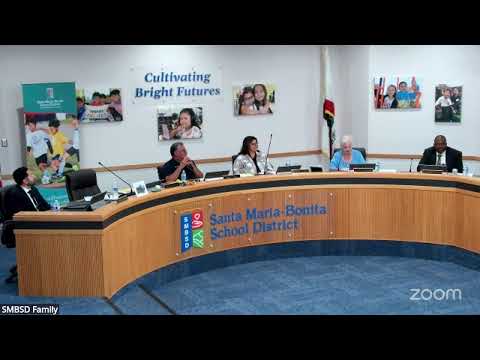
The Santa Maria‑Bonita School District board held a public hearing June 11 on the Local Control and Accountability Plan (LCAP) and heard multiple public comments urging stronger multilingual supports and broader community engagement.
Ivon Duran, chair of the SMIA LCAP committee, thanked the district for changing workshop times and formats to increase parent participation and asked the district to remove “RSVP required” language from flyers so workshops are clearly open to all. Duran also urged the district to include LCAP education in required professional development, noting staff survey response rates were low (about 3% of 2,200 staff reported in winter/spring rounds).
Junior high ELD teacher Lisa Lera said the draft LCAP references new curriculum for EL3 students but that no junior high curriculum for EL3 currently exists; she also said the district has reduced newcomer program access over recent years from two years to one, a change she said has left some middle school newcomers underprepared. ELD coach Rosemary Lopez told the board that the plan’s promise of one bilingual instructional aide per junior high is insufficient given scheduling constraints and the widespread needs of newcomer students.
Dr. Humphrey presented the LCAP update and summarized extensive engagement efforts—workshops, site councils and an online ThoughtExchange—that the district said reached more than 1,600 individuals with roughly 1,850 ideas and about 27,000 ratings. He described how the LCAP aligns investments to the district’s strategic goals, emphasized that staffing is the largest share of proposed investments, and outlined metrics and action/service evaluation questions used to measure effectiveness.
Board members asked how research and evidence guide spending decisions and how the district measures the relative impact of competing investments; Dr. Humphrey said each action/service is tied to implementation questions and goal‑level metrics for progress monitoring. The board acknowledged next steps include a public response to hearing comments and returning the plan for adoption at a subsequent meeting.