Get Full Government Meeting Transcripts, Videos, & Alerts Forever!
Get email alerts on the Budget topic
No spam. Unsubscribe anytime.
Lynwood Unified presents second interim budget, outlines multi-year deficit plan
Summary
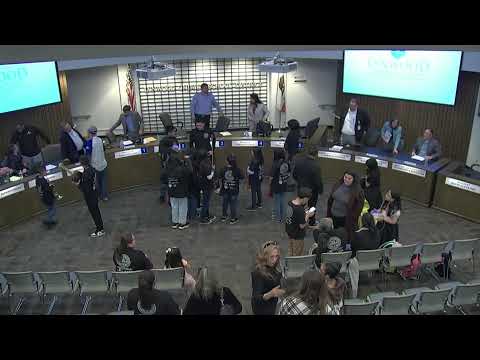
At its March 13 meeting the Lynwood Unified board received a second interim budget showing a balanced current-year position but projected deficits for 2025-26 and 2026-27. District leaders proposed a fiscal-stabilization plan that prioritizes reductions away from the classroom and asks the board to approve required budget-reduction resolutions.
Lynwood Unified trustees on March 13 heard a second interim budget report and a fiscal-stabilization plan that the district said is intended to protect classroom services while addressing projected multi-year shortfalls.
"We have been able under the leadership of this board ... to certify a positive budget," Dr. Jensen said as he presented the district's second interim report, adding that the district's current-year unrestricted revenues and expenditures are both about $147 million and that the district has balanced the budget for 2024-25.
The nutgraf: district officials told trustees the near-term picture is volatile. Superintendent Dr. Gia Cross highlighted falling enrollment, dependence on state income-tax receipts and uncertainty over federal funding, saying, "here in Lynwood Unified we get a little bit over $28 million in federal funds" and that the district remains exposed if one-time or federal sources decline.
Officials summarized the key numbers: historical enrollment has fallen from roughly 15,600 students in 2010 to about 11,000 currently, with projections near 8,000 by 2032; the governor's January proposal showed a 2.43% cost-of-living adjustment, but the district expects funded LCFF to decline from about $180 million this year to roughly $177 million next year (a net funding decrease when adjusted for enrollment and ADA). Dr. Jensen said the district projects a roughly $14 million deficit in 2025-26 and another roughly $8 million in 2026-27 if no corrective action is taken.
To respond, the district's fiscal-stabilization plan focuses on reductions "away from the classroom," including management-position reductions, contract and service cuts where possible, vacancy freezes and a careful review of materials and supply purchases. Dr. Jensen told the board the plan also assumes using restricted funds where allowable and applying staffing ratios to align positions with the smaller projected student population.
Board members pressed for clarity on priorities for high-need students. Dr. Castro asked how the district would ensure services for special-education and other at-risk pupils. Dr. Jensen and the superintendent pointed to the district's strategic plan and ongoing work by committees that look at outcomes and data to inform priority setting.
Trustees approved two related resolutions on the consent agenda: a resolution authorizing the filing of applications with the State Allocation Board for facilities funding and a separate resolution identifying the amount of budget reduction required for 2025-26 and 2026-27. Both passed on voice votes with no recorded opposition (5-0).
Officials said next steps include monitoring the governor's May revision, continuing negotiations with bargaining groups and bringing a more detailed budget presentation back to the board in June. The district also said it would continue state advocacy to protect Proposition 98 funding and to pursue any additional state support for liabilities such as those arising under AB 218.
The board adjourned with a reminder that the next regular meeting is scheduled for April 24, 2025.