Get Full Government Meeting Transcripts, Videos, & Alerts Forever!
Get email alerts on the Organizational Assessment topic
No spam. Unsubscribe anytime.
Consultants tell Sacramento air district board it is ‘on the right page’ but public awareness is low
Summary
Consultants presented results of six board interviews, finding strong internal alignment and trusted leadership but low public awareness; they recommended stepped-up, nonpolitical public engagement, early land‑use coordination and use of trusted messengers.
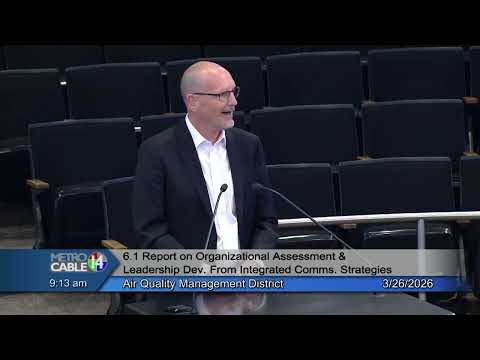
Consultants from Integrated Communications Strategies told the Sacramento Metropolitan Air Quality Management District board on March 26 that the organization is ‘‘on the right page’’ but that public awareness of the district’s role is low and could hinder future work.
Bill Mueller of Integrated Communications Strategies summarized findings from six one-hour interviews with board members, saying the review showed ‘‘partners being local governments, various organizations’’ rated highly while ‘‘public awareness was quite low.’’ Mueller said the interviews identified wildfire smoke, funding and policy uncertainty, and the region’s car‑centric development pattern as the top threats to air‑quality progress.
The consultants recommended a stepped‑up public engagement effort that leans on trusted messengers and stresses data and community health rather than partisan framing. ‘‘Avoid politicization … being data and evidence driven’’ was a recurring message the consultants said they heard from board members.
Directors pressed for clarity about next steps. Director Dickinson asked, ‘‘So what now?’’ pointing to whether the board should schedule a broader discussion of issues where the six‑person sample showed divergence. District staff said recommendations are being integrated into ongoing work and that additional board conversations could be agendized.
Director Hume, describing regulatory interactions with local businesses, argued that the identity of the messenger matters when people feel regulations are punitive: ‘‘We are more powerful and we are more important than you and we’ll let you know when we’ve made our decision,’’ he said, recounting an example where an initial agency message caused frustration despite a quick staff solution.
The consultants and staff suggested the board could use its membership and local partnerships to expand reach, coordinate with transportation and land‑use agencies earlier, and consider targeted public education campaigns that focus on community health. Staff said they will work with the consultants in coming months on implementation and to bring issues back to the full board for discussion.
The board took no formal action on the consultants’ recommendations at the meeting; staff stated the intent to fold the findings into agency communications and to consider future agenda items for board discussion.