Get Full Government Meeting Transcripts, Videos, & Alerts Forever!
Get email alerts on the Interior Drain topic
No spam. Unsubscribe anytime.
Corrales consultant outlines master plan for Interior Drain, schedules public meeting
Summary
Landscape architect Amy Bell presented a draft master plan for the two‑mile Interior Drain, proposing layered access management, habitat restoration and low‑impact traffic controls (flexible bollards); public meeting set for July 9 and council will consider adoption July 22.
Amy Bell, a landscape architect and certified arborist with Anthropopulus, told the Corrales Village Council that a draft master plan for the Interior Drain (also called the SCSI ditch) is ready for public review and is intended as a guiding document — not final design. "This is a master planning document. This is not design," Bell said, adding that most recommendations will need follow‑up design work.
Bell described the drain as roughly two miles long, running east of Corrales Road from Valverde south to the Corrales Riverside drain, and said the Middle Rio Grande Conservancy District (MRGCD) originally built it. Under a 2023 joint powers agreement, management of the village portion of the drain was transferred to the village while MRGCD retains authority over the southern portion, Bell said.
The draft plan’s priorities balance access management, public safety and habitat restoration. Recommendations include creating a west‑side multi‑use path in some sections, designating local‑access lanes on the east side, narrowing entries to slow vehicles and placing flexible bollards at intervals as a visual barrier that emergency vehicles can run over. Bell said the plan preserves 20‑foot emergency vehicle access where required.
Bell also described habitat zones developed with a wildlife biologist, and recommended slope stabilization and phased ecological restoration with native seed mixes. She said the village should favor "light touch" interventions where possible and consider a habitat steward program using volunteers and youth crews to reduce maintenance costs.
Councilors and residents pressed for details on costs, maintenance and jurisdictional limits. Bell said no implementation is funded yet and that the village currently has about $1,500 remaining from the project’s original allotment; she gave a preliminary estimate of $60,000–$80,000 to install bollards and signage. She said larger habitat and earthwork costs remain under study and that more detailed estimates will be available after contractor consultations.
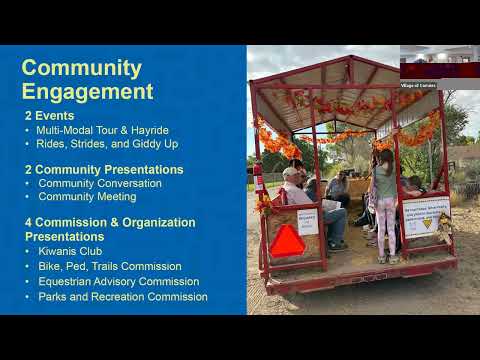
Bell said outreach has included two major community events, a November town conversation and an open survey (September–January) that produced 186 responses; 75 respondents reported daily use of the drain and 43% live on the drain. "People travel the drain most regularly by foot, followed by car, bike and then horse," she said, summarizing survey results.
The council confirmed a July 9 public meeting at 5:30 p.m. in council chambers (with Zoom) for community input on the draft plan; council will consider formal adoption of the plan at its July 22 meeting. Bell emphasized the plan’s phased approach and village maintenance capacity: "If we propose improvements, what does that mean for management, staffing and operational requirements?" she said.
Residents at the meeting urged preserving the drain’s rural character, questioned whether bollards would make the corridor feel "urban" and asked about effects on adjacent farmers, parking, and school‑related traffic. The consultant said design choices (bollard color, material and placement) will be refined in later design phases so they better blend with the drain’s rural setting.
The council did not vote on any implementation actions at the meeting; the process will proceed through the July 9 community meeting and the July 22 council consideration.