Get Full Government Meeting Transcripts, Videos, & Alerts Forever!
Get email alerts on the Audit Timeliness topic
No spam. Unsubscribe anytime.
Public auditor warns late audits threaten Guam budgeting; DOA points to staffing and GFMIS transition
Summary
At a March 10 oversight hearing, Public Auditor BJ Cruz said missing drafts and late component-unit work have pushed Guam’s FY2024 audit past statutory timetables; DOA officials said audit quality and resource constraints, GFMIS transition and EY staffing complicate timing. Cruz signaled use of new fine authority to enforce deadlines.
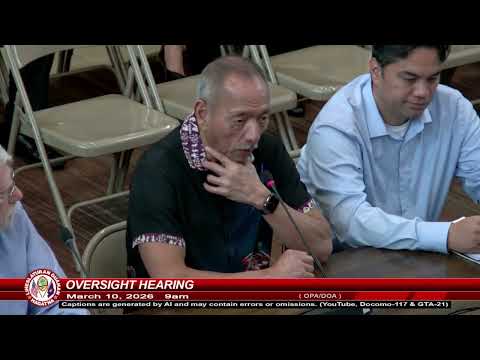
The Committee on Finance and Government Operations held an oversight hearing March 10 as the Office of Public Accountability and the Department of Administration gave conflicting accounts of why Guam’s government-wide FY2024 audit remains incomplete.
Public Auditor BJ Cruz told the committee that his office gave EY (Ernst & Young) contract authority to complete government audits on a schedule that would allow the Guam audit to be issued early in the year so legislators could use audited FY2024 numbers in budget deliberations. Cruz said he received a compliance-draft on Jan. 31 but has not seen final drafts, the management discussion and analysis (MD&A) or other documents needed to finalize the audit and that component-unit delays — particularly from agencies with substantial federal funding — are blocking completion.
"I received a fairly long compliance part of the FY2024 compliance report on Jan. 31," Cruz said. "I haven't seen the MD&A. I haven't seen the draft financial statements. If departments don't provide information on time, audits can't be finished." Cruz also described a sweep of questioned federal costs that initially totaled roughly $37.6 million and said his office set an internal working threshold of $15 million to force closure on compliance follow-ups.
DOA Director Ed Burn said the audit process is unusually complex this year because of a mix of new federal grants, technical accounting changes and a phased transition to a new Guam Financial Management Information System (GFMIS). Burn confirmed EY has indicated staffing shortfalls but said the greater problem is that some agencies have not met milestones to supply auditors with trial balances and source documentation.
"EY needs people, but if the departments would just follow the schedule…they have milestones to meet," Burn said. "When one agency falls behind, the critical path for the whole government audit breaks down." He added that DOA is proposing to use a $250,000 Department of Interior grant to acquire software that would let DOA prepare financial statements in-house and reduce dependence on external firms.
Several senators pressed both witnesses on which is to blame: EY’s short staffing or agency noncompliance. Cruz said both matter. Burn said he had never seen an audit cycle as fraught but said quality must not be sacrificed for speed.
On the special-act enforcement front, Cruz said he plans to implement the Office of Public Accountability’s new penalty schedule under Public Law 38-9. He told the committee he will demand acknowledgements from the actuary within 30 days on OPED (other post-employment benefit) census submissions and that late submissions may trigger fines starting at $250 and escalating for continued delays.
DOA’s presentation to the committee also covered GFMIS progress, procurement and human resources. CFO Teresa Rivers said DOA is producing monthly budget-vs.-actual reports and that the GFMIS rollout has improved reporting, but admitted key interface problems remain: payroll-to-accounting migration and invoice-PO matching have required manual checks and have produced W-2 corrections for some employees. DOA and the GFMIS vendor are working service requests to correct those interfaces.
Procurement leaders said the agency currently has five buyers but would need roughly a dozen to process current demand promptly. GSA said it has closed roughly 59% of 1,412 FY2026 requisitions to date but cited returned requisitions when funding or supporting documents are missing. Senators and DOA officials agreed procurement staffing, clearer agency budgeting and better use of consolidated solicitations would reduce delays and vendor payment aging.
The committee recorded broad agreement that timely, quality audits are essential for credible budgeting. Several members said if an audited FY2024 is not available they will prepare a conservative budget for the upcoming cycle. Cruz said his office will press deadlines and use its statutory authority to hold agency heads personally accountable for late submissions.
The committee accepted written testimony for seven days and adjourned at 1:32 p.m.