Get Full Government Meeting Transcripts, Videos, & Alerts Forever!
Get email alerts on the Sentencing Policy topic
No spam. Unsubscribe anytime.
Commission begins review of offenses resulting in death; staff outlines ranking criteria and deadlines
Summary
Staff told the Sentencing Guidelines Commission it will revisit how offenses that result in death are placed on the severity grid, emphasizing harm and culpability, statutory maximums, and challenges where statutes bundle death with lesser harms. Members discussed unranked-offense thresholds, adulteration statutes, and recent felony-murder accomplice reforms; staff set a March 23 deadline for written ranking inputs.
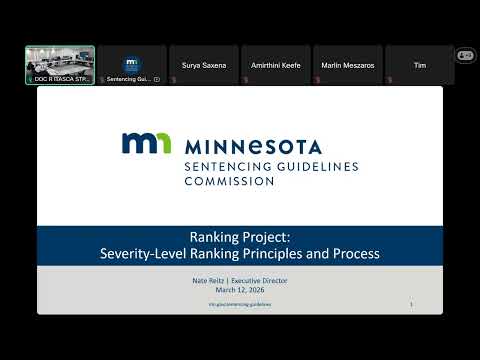
Staff presented the commission’s continuation of the comprehensive review, focusing on offenses that result in death and guiding commissioners through the ranking framework used to place offenses on the severity grid.
Staff said the commission relies primarily on two axes — the harm caused and the culpability of the actor — and uses statutory maximums and comparisons to neighboring offenses to place a typical offense on the grid. "The two big things that the commission's looked at historically have been the harm and the culpability," staff explained, noting examples such as criminal vehicular homicide where severe harm combined with lower culpability yields a lower severity level than intentional murder.
Staff emphasized classification challenges when a single statute covers a wide range of conduct, including both death and lesser harms. Using the adulteration statute as an example, staff described a hypothetical in which conduct intended only to cause illness could nonetheless result in death: "If I poison your goblet... if I poison your goblet and you drink it and die ... it makes sense that that would be ranked at 11. But the statute also covers conduct that the actor may only have intended to cause illness," staff said, arguing that the statutory design can produce proportionality concerns.
Commissioners asked about thresholds for treating unranked offenses as candidates for ranking. Commissioner Lad asked, "Do we have a magic number uh for those unranked offenses? Like how many cases do we need before we're going to take a look at it?" Staff replied there is no automatic numeric trigger and that either staff or a commissioner must initiate follow-up; commissioners discussed forming a subcommittee or scheduling periodic staff reviews to flag candidates.
Members also discussed recent legislative changes affecting felony-murder accomplice liability, noting the new statutory qualifiers (major participant + extreme indifference to human life) and uncertainty about how those reforms will affect resentencing and future caseloads. Staff noted labor trafficking resulting in death was a newly ranked offense and that several items in the packet presented unusual ranges of harm, which the commission must weigh in its ranking.
For this exercise staff provided worksheets and data visualizations (cases per year, estimated prison-bed impact, departure rates by criminal-history band) and set a submission deadline: draft ranking inputs are due by noon on Monday, March 23. Staff asked commissioners to return marked worksheets or form-fillable inputs so staff can prepare agenda materials two weeks before the next meeting.