Get Full Government Meeting Transcripts, Videos, & Alerts Forever!
Get email alerts on the Infrastructure Blueprint Hilltop 4 topic
No spam. Unsubscribe anytime.
City of Columbus outlines Hilltop 4 Blueprint upgrades and free lead service-line replacements
Summary
City of Columbus staff described the Hilltop 4 Blueprint stormwater and sanitary-sewer improvements, timetable for rain gardens and permeable pavers, and a program to replace lead and galvanized household water service lines for free when tied to planned city work.
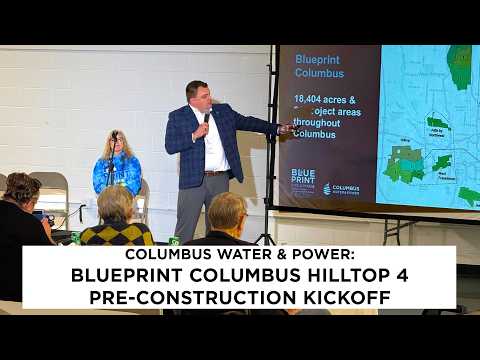
City of Columbus staff on a neighborhood outreach night described the Hilltop 4 Blueprint project, what residents will see in coming months and how the city will replace lead and galvanized water service lines at no direct cost to homeowners when the work ties to planned city construction.
Cameron Keir, City of Columbus staff leading the presentation, said Blueprint was created to meet sanitary sewer overflow consent-order obligations and to invest in aging infrastructure across neighborhoods including the Hilltop. Keir explained the program’s two main goals are to reduce sanitary sewer overflows and to treat stormwater before it reaches rivers and streams, adding that “all of these products are offered to you at no additional charge.”
Keir and Jeremy, the project manager in the Division of Water Reclamation, described design features residents will see: rain gardens planted with native Ohio species, permeable pavers on select low-speed streets, and lateral-lining work that repairs the pipe connecting homes to sewer mains from the inside. Jeremy said crews broke the neighborhood into four contract quadrants, plan to start in the northeast quadrant, and that some rain-garden site survey work was already under way.
Project sequencing and resident impacts: staff said rain gardens are visible, aboveground elements of the work and that permeable paver streets will generally follow once rain-garden planning is complete. Individual rain-garden construction typically requires about 3–6 weeks from excavation to planting; city staff said a given street section removed for street reconstruction can be closed to parking for roughly nine weeks while work is underway, with pedestrian access maintained and advance notices provided to affected homes.
Maintenance and ownership: staff explained rain-garden basins are located in the public right-of-way (generally about 30–60 feet from the street center) and that the city is responsible for ongoing maintenance under contractor agreements. Keir said the city expanded maintenance contracts to five crews to perform inspections, weeding, mulching and trash removal on a regular schedule.
Lead and galvanized water service lines: Hannah, representing the City’s Let’s Save Columbus program, said crews will replace lead and galvanized water service lines when they are exposed during planned construction or water-main work. She described the homeowner-side and city-side portions of a water service line and emphasized the replacement is “a free upgrade to you” when done as part of planned city construction. Hannah added the replacement program is being conducted to meet federal requirements and that the city is continuing a wider, systemwide effort to remove lead and galvanized lines over time.
Specific imminent work: Hannah identified a water-main replacement on South Burgess Avenue expected around October and said residents in the immediately affected block should sign a work agreement to authorize a free in-home service-line replacement. Staff had an outreach table at the meeting and offered to look up individual addresses to confirm impacts and next steps.
Resident questions and concerns: attendees asked about the timing for adjacent zones (Jeremy estimated the neighboring zone in the 2029–2030 range), ADA access and alley parking impacts (residents were directed to speak with engineers at the open house for property-specific accommodations), whether prior water-main replacements eliminated lead lines (staff said city-side replacements have proceeded for years but homeowner-side lead lines may remain and require address-by-address verification), and whether yards will be dug up for service-line replacements (Hannah said the city uses minimally invasive pull/replace techniques rather than long trenches, though access holes are required).
What to expect next: staff encouraged residents to look for impact cards the city distributed to affected homes, sign up for weekly construction updates, and visit outreach stations to confirm any specific concerns about parking, ramps or trees. Staff also asked neighbors to report spills or illegal dumping to the stormwater prevention hotline and to avoid altering marked rain-garden basins.
The presentation portion ended with the moderator inviting attendees to speak one-on-one with engineers and contractors stationed at outreach tables to get property-specific information.