Get Full Government Meeting Transcripts, Videos, & Alerts Forever!
Get email alerts on the Education Performance topic
No spam. Unsubscribe anytime.
Presenter tells State Board NH reading and math scores lag; urges focus on teacher effectiveness and data-driven oversight
Summary
A presenter at the State Board of Education meeting showed decade-long data indicating declines in New Hampshire reading and eighth-grade math, linked staffing shifts to federal relief spending, and urged redeploying staff into tutoring and better principal-level use of data to improve outcomes.
A researcher presenting to the State Board of Education said New Hampshire’s reading and math performance has fallen substantially over the past decade and urged state and local leaders to focus on teacher effectiveness and data-driven oversight rather than solely on inputs such as staffing levels.
The presenter said the green line in his charts showed actual spending while test results for reading and eighth‑grade math “have fallen really quite a bit,” adding that a 10‑point change on the scale he used equates to about one year of learning. “Teacher effectiveness trumps class size every time,” he said, arguing that keeping a ‘‘rockstar’’ teacher in front of more students is likely to produce better outcomes than reducing class size while losing top teachers to non‑classroom roles.
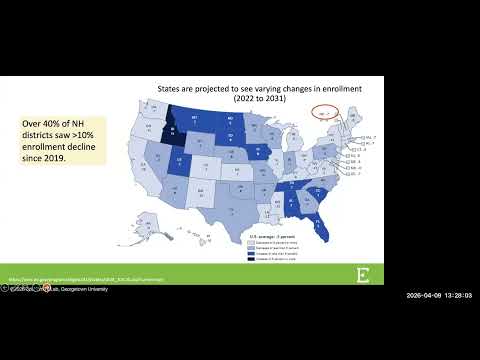
Why it matters: The presenter tied declining test results to long-term trends and to demographic shifts. He noted a projected roughly 7% decline in the school‑age population for New Hampshire and said about 14% of districts have lost more than 10% of enrollment since 2019, complicating budget and staffing decisions.
Key evidence and claims: Using decade‑long state and national samples, the presenter showed that New Hampshire’s reading levels are about a year behind where peers were a decade ago and math is more than a year behind. He warned that the most recent uptick in math scores remains insufficient to erase a longer downward trend. On staffing, he said the state lost approximately 14,000 students while the number of non‑classroom certificated positions grew—roughly 2,000 new positions in school‑based non‑teacher roles and roughly 450 in district administration—changes he traced in part to federal ESSER relief funding.
Questions from board members focused on whether ESSER‑funded hires (for example, counseling and social‑emotional positions) were converted into permanently funded local roles after federal funds expired and whether there is evidence those hires improved academic outcomes. The presenter said the evidence that these additional staff improved math or reading outcomes is limited and recommended redeploying some staff into targeted small‑group tutoring if districts have excess capacity.
Special education: The presenter highlighted that New Hampshire’s special education identification rate (about 19% in the presenter’s account) exceeds the national average (about 16%) and cautioned that weaker early reading instruction can lead to higher referral rates. He said some special education programs are staff‑heavy and recommended examining whether staffing mixes are delivering measurable value for students with disabilities.
Recommendations and next steps: The presenter urged board members to require annual data reviews by principals and district leaders, to make performance data more visible to parents, and to consider redeploying staff into tutoring or targeted interventions. He also described a two‑day Georgetown certificate program in finance and ongoing training options to build district capacity.
What the board did: This session was informational; no board policy vote on the presenter’s recommendations was recorded. Board members asked for follow‑up materials and slides the presenter said he would share.
Representative quotes: “Reading and math have fallen really quite a bit,” the presenter said, and later: “Teacher effectiveness trumps class size every time.”