Get Full Government Meeting Transcripts, Videos, & Alerts Forever!
Get email alerts on the Wildfire Resiliency Code topic
No spam. Unsubscribe anytime.
Alamosa staff outline state wildfire code, council debates map options amid affordability worries
Summary
City staff presented the state-mandated Colorado Wildfire Resiliency Code and three map options for where it would apply; council members expressed concern that stricter local maps could raise construction costs, harm affordable housing projects and risk grant funding if the city refuses the state minimum. No vote was held; staff will bring a first reading next week.
City staff reviewed the Colorado Wildfire Resiliency Code (CWRC) and three possible local maps at an Alamosa City Council work session, laying out the timeline staff said requires a local adoption process and prompting a debate over whether to adopt the state minimum or expand protections beyond the state’s base map.
The presentation, led by staff members Rachel and Frank, explained that the CWRC stems from a state bill referenced in the meeting as "state bill 23166" and that the code applies primarily to new construction and certain renovations. Rachel told council that detailed implementation guidance and the mapping advice arrived only recently, and that the city faces a tight schedule to bring an ordinance forward.
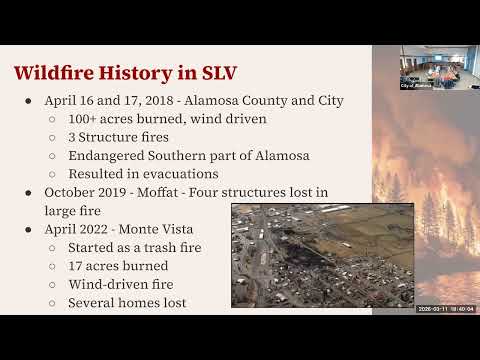
Why it matters: staff said the code is intended to reduce building losses and keep insurance available in Colorado by requiring "hardening" measures—noncombustible roofing and flashing, ember-resistant vents, protected gutters, tempered or insulated glazing and other steps intended to limit ember and radiant-heat ignitions. Frank, speaking from the fire-safety perspective, cited local incidents and rising statewide fire severity to justify the protections.
Still, several council members pushed back on broader local adoption because of cost and capacity concerns. Councilor Carson warned that higher materials and labor costs could price out affordable housing projects and developers, noting examples from local bids: "the difference between the same door in wood and metal was about 700 bucks," and alternative fencing materials could be 25–50% more expensive, staff said. Rachel said staff compiled local cost estimates and presented an example that staff calculated would be about a $16,000 increase for a 1,500-square-foot home under the stricter class-two requirements.
Grant and enforcement risks: staff said a substantial share of local capital projects rely on state grant funding—Rachel estimated "95% or more" of the city's grant dollars come from state programs—and warned that some jurisdictions have seen grant eligibility affected when they do not adopt state-required standards. Staff also warned the city’s small building department could face enforcement and recordkeeping burdens if broader local requirements are adopted.
Map choices and staff views: staff presented three options: A) adopt the state base map (the minimum); B) adopt a hybrid map (state map plus staff-identified parcels likely to develop); or C) apply the lower-risk (class-one) standards citywide. Rachel said staff leaned toward the state minimum given the compressed timetable; Frank recommended map C as a relatively low-cost, citywide precaution (he described class-one requirements as the most balanced on cost versus protection).
Public comment and insurance concerns: in Zoom public comment, Priscilla Wagner said several insurers have limited coverage or withdrawn markets in Colorado and said premiums for some policies have risen dramatically—she cited companies and a figure of "premiums up 180%"—and asked whether roof replacement triggers the CWRC. Staff replied that a full roof replacement or replacement of 25% of the roof area in a regulated zone would trigger the CWRC roof standard; they said other house components are not automatically required unless a larger renovation meets the usual renovation thresholds.
Next step: staff told council they will bring an ordinance for a first reading at the council’s next regular meeting (staff indicated April 18) with a second reading and possible adoption to follow in April. No formal vote was taken at the work session.
Quotes: Frank, describing local fires and the intent of the rules, said: "we had a pretty large fire here... a couple hundred acres... it did progress from building to building and that's an issue." Rachel summarized the local scheduling pressure: "we have to adopt it by April 1st," adding that in many cases the state's maps and guidance only recently arrived. Councilor Carson cautioned on affordability: "it's going to be expensive ... it's going to be a huge hit" for some homeowners and projects. In public comment, Priscilla Wagner said insurers' decisions are already changing coverage: "there have been seven insurance companies... that have either pulled out of Colorado ... or have limited where they will insure."
What was not decided: council did not pick a map option or adopt an ordinance at the work session. Staff said they will return with a draft ordinance for first reading next week, and council members signaled a preference for the state-minimum map among several members but did not take a formal vote.
Context: staff emphasized the code is not retroactive; existing structures are generally affected only by the code when renovations or rebuilds meet the thresholds the code specifies. Staff also noted an administrative "ground-truthing" process to review parcel-specific concerns if owners appeal their mapping.
The council will consider the ordinance at first reading on the next regular meeting date; the work session closed without a formal action.