Get Full Government Meeting Transcripts, Videos, & Alerts Forever!
Get email alerts on the Cannabis Regulation topic
No spam. Unsubscribe anytime.
Lake County supervisors debate big setback increases, odor rules and permit protections in proposed cannabis ordinance
Summary
County staff proposed amendments to Article 27 that include reduced-canopy rules, required compliance visits, public posting of inspection/performance reports and stronger odor-mitigation requirements. Supervisors and the public clashed over proposed increases to setbacks (200 ft to up to 1,000 ft) and protections for already-approved projects; the hearing was continued to May 12 for a revised draft.
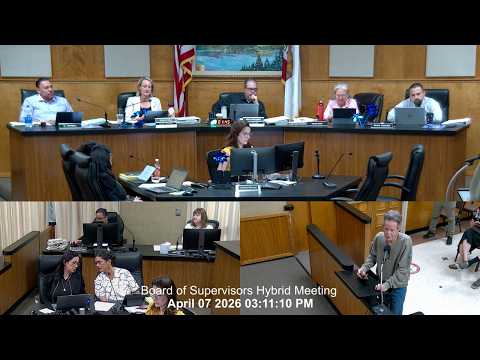
County staff and supervisors spent several hours debating proposed changes to Lake County’s commercial cannabis regulations during a continued public hearing on the Article 27 ordinance.
Miria Turner, the county’s community development director, told the Board the draft amendments respond to prior direction and the county’s recent consultations with the regional Air Quality Management District. Turner said staff would return with a redline of Article 27 (and related edits to Article 19) and an updated ordinance after supervisors gave direction on unsettled items such as setbacks. “We met with the air pollution control officer with the air quality management district,” Turner said, and staff incorporated new mitigation measures into the draft, including an odor-management plan modelled on Yolo County’s 7:1 clean-air-to-odorous-air standard and additional monitoring requirements.
The package of proposed changes would also: clarify retail permitting for community commercial (adding a minor-use permit in C2); require two compliance monitoring site visits for mixed-light and indoor cultivation with reduced-canopy years; make annual inspection and performance reports publicly available (redacting proprietary information); and add a financial security (a $5,000 shy bond) in the draft code tables.
Much of the meeting focused on two flash points: how small a reduced-canopy year should be before it effectively counts as inactivity, and how far cannabis cultivation should be set back from off‑site residences.
On reduced-canopy and inactivity, staff described current practice: a permit is voided after two consecutive years of inactivity, whereas a reduced‑canopy year is intended to keep a permit active. Turner presented the lowest state license type (Type 1C: 2,500 ft² outdoor or 500 ft² indoor) as a baseline, and the Board debated whether to instead require a percentage of the approved canopy. “I would think that it should be in accordance to what their allotted amount is… maybe not less than 25%,” said one supervisor during the discussion; the County Treasurer/Tax Collector urged a substantial minimum so the tax office is not unduly burdened tracking tiny amounts of activity.
The biggest dispute came over setbacks and odor. Staff shared multiple mitigation options — site selection and layout, vegetative buffers, prevailing‑wind analysis, staggered harvests and professional odor studies — and an inverse‑square calculation staff used to model distances from a notional 10,000 ft² canopy. Turner said professionals (engineers, certified industrial hygienists or qualified odor consultants) could provide the wind and odor analyses needed to justify reduced setbacks.
Public comment was sharply divided. Growers and supporters argued that cannabis is agriculture and that doubling or quintupling setbacks would retroactively render many existing, permitted projects nonconforming. In a representative appeal, Clay Shannon (read into the record by Angie Shannon) said: “Cannabis is agriculture. It belongs alongside vineyards, pears, walnuts… The proposed increase in setbacks from 200 feet to 1,000 feet puts that stability at risk.” Several speakers warned that rules that change established approvals would chill investment and cost jobs.
Other residents and several commenters described repeated odor events and alleged health effects. Bill Wilson, who said he lives near a permitted greenhouse, told the Board his household has repeatedly experienced odor events and cited California’s nuisance rules: “There’s no doubt that there is an annoyance from the odor… It causes headaches, it causes nausea,” he said.
Several legal and business speakers urged the Board to adopt protections for projects that have completed substantial processing or discretionary approvals. Attorney Timothy Cassooni and others said applicants with a completed application or planning commission approval should receive express protections so years of staff and applicant effort are not upended.
Supervisors discussed using zoning to tailor setbacks. Preliminary direction included: a 1‑acre maximum canopy and 500‑foot setback in rural residential (RR); 300 feet in rural lands (RL); and holding agriculture (A), APZ and TPZ at the existing 200‑foot setback while staff refines the mapping. Supervisors also emphasized that mixed‑light or engineered greenhouse cultivation should not emit odors and should meet air‑quality permit and filtration requirements.
Board members repeatedly asked staff to map which existing permitted projects would become nonconforming under any chosen setback scenario and to coordinate with the Treasurer/Tax Collector on any reduced‑canopy reporting threshold. The Board directed staff to return with the revised draft, supporting materials and maps on May 12, 2026, at 1:00 p.m. The board agreed the May 12 return should be a staff presentation of the draft rather than a formally noticed first reading so the public will have the full revised ordinance in advance.
What happens next
Staff will provide (1) a redline of Article 27 and related code tables; (2) parcel- and permit‑level mapping showing which approved projects would be nonconforming under proposed setbacks; (3) recommendations for a reduced‑canopy minimum (percentage or square footage) in coordination with the Treasurer/Tax Collector; and (4) proposed odor‑management/performance standards and the air‑quality permitting implications for greenhouse filtration systems. The item was continued to May 12, 2026 at 1:00 p.m.
(Reporting note: At the hearing the director’s name appears in the transcript as both “Mera Turner” and “Miria Turner.” The county’s materials and public comments repeatedly identify the community development director as Miria Turner; this article uses Miria Turner.)