Get Full Government Meeting Transcripts, Videos, & Alerts Forever!
Get email alerts on the Housing Development topic
No spam. Unsubscribe anytime.
Neighbors object as Development Commission approves 296‑unit Hey Avenue project; developer vows roadway improvements
Summary
The commission approved a 296‑unit multifamily rezoning at 1753 North Hey Avenue despite strong opposition from the West Sciota Area Commission and multiple residents, who cited density, building height, stormwater and service concerns; the developer committed to a turn lane, shared‑use path and other mitigations.
The Columbus Development Commission on June 9 voted to approve a rezoning request at 1753 North Hey Avenue that would allow a 296‑unit multifamily development, after the applicant revised plans and offered a set of infrastructure and design commitments.
Developer Metropolitan Holdings presented iterations of the proposal that reduced unit counts, removed variance requests and increased open space from 35% to 43%. Project manager Megan Dower told the commission the team will fund roadway improvements identified in an approved traffic impact study — including a 225‑ft northbound left‑turn lane and an 11‑ft shared‑use path along Hey Avenue — and will add about seven fire hydrants and perimeter screening. Planning staff recommended approval, citing consistency with the city’s recently adopted Columbus Growth Strategy and nearby multifamily development patterns.
Opponents — including Rita Cabraw, speaking for the West Sciota Area Commission, and multiple nearby homeowners — urged disapproval. Cabraw argued the requested L1 apartment residential zoning and three‑story building types are out of scale with adjacent single‑family neighborhoods and said the proposal “exceeds the plan recommendation” for the area; she asked the commission to hold the developer to a lower density target (12–15 units per acre). Residents raised additional concerns about stormwater and erosion on the sandy stream corridor, the timing of proposed sidewalks and a shared‑use path (which residents said may not be built for several years), emergency‑response capacity, and the concentration of recent apartment projects in the neighborhood.
Developer counsel and planning staff responded that the project was revised repeatedly in response to neighborhood feedback, that variances were removed, and that the county‑approved traffic impact study requires the road improvements the developer will construct. The project team also said building heights are within the 35‑ft height district and that some roof midpoints reach ~40–41 ft only where the code allows step‑up/setback calculations.
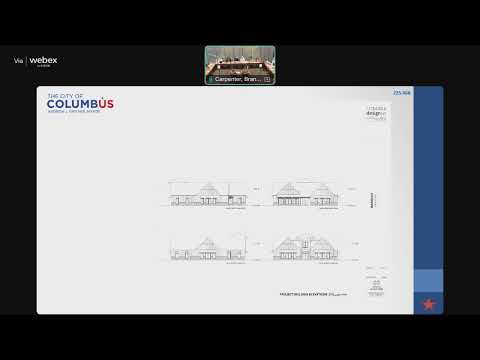
Commissioners voted to include the day’s landscape plan and building elevations as part of the record and to forward the approval; roll call recorded unanimous yes votes by the commissioners present.
What comes next: project applicants must satisfy engineering and stormwater controls at permitting, and county/city departments will enforce the traffic‑study required improvements. Neighbors and the West Sciota Area Commission have said they will continue to press council members and staff for stronger guarantees on buffering, phasing of road/path construction, and stormwater protections.