Get Full Government Meeting Transcripts, Videos, & Alerts Forever!
Get email alerts on the City Revenue Forecast topic
No spam. Unsubscribe anytime.
Seattle Forecast Office Recommends Baseline Revenue Forecast; Council Records Concurrence amid Global Uncertainty
Summary
The City of Seattle’s forecast office recommended adopting a baseline revenue forecast for 2026 — citing higher assessed values and new tax classifications — while warning that an extended oil‑price shock could cut revenues by about $90 million; the Forecast Council recorded concurrence and asked staff and departments to plan conservatively.
The City of Seattle’s Office of Economic and Revenue Forecasts recommended the baseline scenario as the official April 2026 revenue forecast on April 10, and the Forecast Council recorded its concurrence in the meeting minutes. Interim Director Duras told the council the baseline incorporates an average of S&P Global and IHS Analytics projections but adjusts for recent oil‑price and market moves tied to the conflict in Iran.
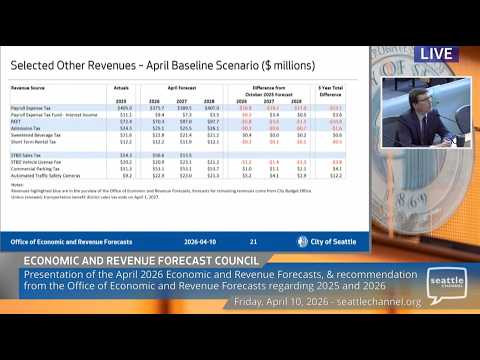
Duras said the baseline projects a roughly 9.1% increase in general‑fund revenues for 2026 — a jump largely driven by recently enacted sales‑tax changes and a reclassification of certain business activity under ESSB 5814 — while noting the forecast remains highly uncertain. "We feel confident we have mitigated some of those risks by incorporating elements of more pessimistic scenarios into our baseline," Duras said during the briefing. He added that the pessimistic scenario would cut about $90 million from 2026 revenues while an optimistic case could add roughly $30 million.
Staff reviewed 2025 close‑out figures that informed the April update: final general‑fund revenues were about $7.1 million above the October forecast (roughly a 0.4% variance), and revenues excluding grants and transfers were about $55 million higher than projected. The forecast office cautioned that some of the favorable 2025 figures reflect late payments and multi‑year grant timing that do not necessarily predict next‑year growth; staff said roughly $6 million in expected refunds will reduce next‑year receipts.
The presentation highlighted district and sector trends that shaped assumptions: regional employment was down only slightly in 2025 (about -0.1% actual versus a larger decline expected earlier), inflation for the year came in near 2.4% locally, and taxable sales modestly outperformed expectations. However, staff flagged structural and near‑term risks: high office vacancy rates (expected above 20% through 2030) and tech‑sector layoffs and lower stock prices that reduce payroll‑expense tax collections. "The pessimistic scenario would mean $90 million less in revenue," Duras said, quantifying downside exposure.
Chair Dan Strauss asked for objections to adopting the baseline as the council’s official forecast; none were offered, and he instructed staff to record the council’s concurrence in the minutes. Strauss and other members urged city departments to plan conservatively given the breadth of uncertainty and possible downside outcomes.
The forecast office said it will publish revised forecasts in August and October and maintain a public dashboard of quarterly revenue updates. The council agreed to hold additional work sessions in June or July to dig into new and volatile revenue streams such as the social housing tax and the payroll‑expense tax.