Get Full Government Meeting Transcripts, Videos, & Alerts Forever!
Get email alerts on the Sea Level Rise topic
No spam. Unsubscribe anytime.
Monterey launches 'Resilient Coast Monterey' plan to assess and adapt to sea level rise
Summary
The City of Monterey announced Resilient Coast Monterey, a two‑phase assessment and adaptation project funded in part by a California Coastal Commission grant. The plan will produce a final local coastal program amendment targeted for adoption by December 2027 and seeks community input on risks and strategies.
A presenter for the City of Monterey announced the launch of Resilient Coast Monterey, a city-led assessment and adaptation plan intended to prepare Monterey’s coast for the effects of sea level rise. The presenter said the project will identify potential impacts, propose adaptation strategies and quantify costs and benefits to inform policy decisions.
The project has five goals, the presenter said, including documenting likely effects on people, buildings, roads and natural areas using updated best-available science; proposing strategies to help communities and ecosystems withstand impacts; and consolidating and updating the city’s local coastal program so officials have “a step-by-step road map to decide how to prepare for future sea level rise scenarios.”
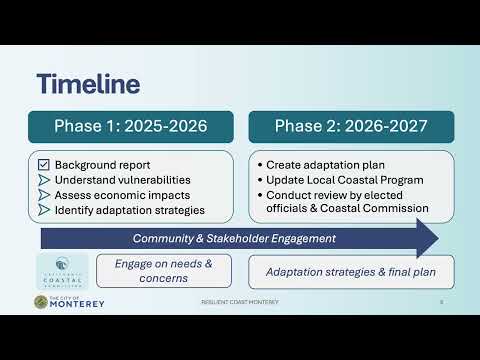
Phase one began in 2025 and, according to the presenter, includes compiling existing data and prior sea level rise work into a background report that the city has posted on the HaveYourSayMonterey website. The presenter said a vulnerability assessment is under way and that the city will conduct an economic analysis and identify preliminary adaptation strategies during the current phase.
Phase two is scheduled to start later in 2026 and continue into 2027, at which point the city plans to create a final adaptation plan that will inform a local coastal program (LCP) amendment. The presenter said the LCP amendment is scheduled for completion and adoption by December 2027 after review and approval by Monterey’s Commission, the City Council and the California Coastal Commission.
On funding, the presenter said phase one is supported by the California Coastal Commission’s local assistance grant program and that the city is identifying funding sources for phase two. For public input, the presenter outlined two engagement stages: phase one solicits needs and concerns; phase two seeks feedback on draft adaptation strategies and the final LCP. Planned outreach methods include community meetings, tabling at community events, an online survey, focus groups and partnerships with local organizations.
The presenter also summarized the science behind sea level rise, noting that warming seas expand and melting glaciers and ice sheets add freshwater to oceans, both of which raise global sea levels. The vulnerability assessment will document likely impacts through 2100 and will note that impacts vary along different parts of the coast and grow larger under higher sea level projections. The presenter pointed to current impacts such as king-tide coastal flooding, damage to roads and infrastructure, beach and shoreline erosion that can expose utilities, and harm to fragile ecosystems.
The city invited residents and stakeholders to follow the project and sign up for updates at haveyoursaymonterey.org. The presenter closed the video by thanking listeners and reminding them of upcoming engagement opportunities.
Next steps: the city continues technical analyses and public outreach in phase one, seeks funding and plans to begin phase two in late 2026, with the LCP amendment targeted for adoption by December 2027.