Get Full Government Meeting Transcripts, Videos, & Alerts Forever!
Get email alerts on the Coastal Resilience topic
No spam. Unsubscribe anytime.
Monterey outlines coastal resilience plan to prepare city for sea-level rise
Summary
The City of Monterey released a video overview of "Costa Resiliente Monterey," a five-objective coastal resilience plan. Phase one began in 2025 (funded by a California Coastal Commission local assistance grant); phase two runs through 2027 and will produce a Local Coastal Program amendment for review by the Planning Commission, City Council and California Coastal Commission.
A city presenter said the City of Monterey is launching "Costa Resiliente Monterrey," a coastal resilience initiative to assess and adapt to the risks posed by sea-level rise.
The plan, the presenter said, has five objectives: identify potential sea-level-rise impacts on people, streets, buildings and natural areas using updated science; propose adaptation strategies for communities and ecosystems; quantify impacts and estimate costs and benefits for decision-makers; consolidate and update the local coastal plan; and create a detailed coastal map to guide preparations for future scenarios.
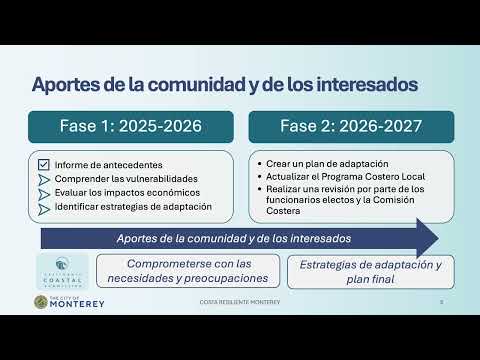
The presenter said the work is organized in two phases. Phase one began in 2025 and is ongoing; staff have compiled existing-condition data and previous studies and published a background report online. The city is conducting a vulnerability assessment that is still in progress and plans an economic analysis and preliminary adaptation strategies this year. Phase two is scheduled to begin late in the year and continue through 2027, during which the city will develop a concrete adaptation plan and prepare an amendment to its Local Coastal Program for adoption.
The video notes the Local Coastal Program amendment will undergo review and approval by the Planning Commission, the City Council of Monterey and the California Coastal Commission, with targeted completion and adoption in 2027. The presenter identified the first phase's work as funded by a California Coastal Commission local assistance grant and said staff are seeking additional grants to support phase two.
The presenter described current coastal impacts Monterey is already experiencing, including flooding during high "king tides," damage to roads and other infrastructure, property impacts and beach erosion that can expose utilities and harm fragile ecosystems. The video frames the vulnerability assessment as a tool to document likely impacts along different parts of the coast and to inform cost'benefit comparisons among adaptation options; the presenter did not specify the terminal year for the assessment's projection horizon in the video.
Community engagement is built into the schedule, the presenter said: phase one solicits input on community needs and concerns; phase two will seek feedback on proposed adaptation strategies and the draft Local Coastal Program amendment. Planned outreach methods include community meetings, information booths at local events, an online survey, focus groups and partnerships with local organizations. Residents are invited to follow the project on the "Have Your Say Monterey" portal and subscribe for updates.
The presentation is informational rather than a formal decision; no motions or votes were recorded in the video. The timeline and funding sources described indicate the project will require subsequent staff reports and regulatory review before any Local Coastal Program amendment is adopted.
A city presenter closed the video by encouraging public participation and thanking viewers.