Get Full Government Meeting Transcripts, Videos, & Alerts Forever!
Get email alerts on the Budget topic
No spam. Unsubscribe anytime.
Mayor Parker unveils $7 billion "One Philly, One Future" budget with $2 billion housing plan and new local taxes
Summary
Mayor Charerelle L. Parker proposed a $7 billion FY2027 operating budget and five‑year plan that prioritizes housing, public safety, transit access, workforce development and homelessness services, funded in part by a proposed rideshare tax, retail delivery fee and other targeted levies.
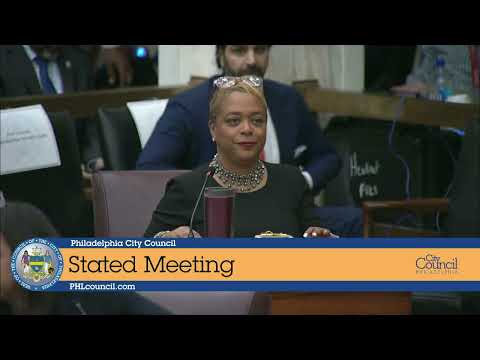
Mayor Charerelle L. Parker delivered her proposed fiscal year 2027 budget to Philadelphia City Council on March 11, calling it "One Philly, One Future" and describing a $7 billion spending plan that she said is aimed at making the city "safer, cleaner, and greener with access to economic opportunity for all." She framed the package as a mix of new investments and targeted revenue measures to support housing, public safety, transit and workforce programs.
The administration’s headline housing commitment is a $2 billion Home Initiative that, according to the mayor, aims to create and preserve tens of thousands of units — including 20,000 deeply affordable units in partnership with the Philadelphia Housing Authority — and to provide a menu of programs described as a "one Philly mortgage," basic home repair grants, adaptive home modifications and Turn the Key homeownership projects. "Help and housing is on the way," Parker said in the chamber, urging council support for the borrowing that would fund the program.
Parker highlighted public‑safety and prevention investments, including a pledge of $25 million in community‑based antiviolence grants and the deployment of body‑worn cameras to officers across patrol districts. On transit and schools, the mayor proposed a 20‑cent-per-ride transportation network company tax (rideshare tax) she estimates would raise about $9.6 million a year to be dedicated to the School District of Philadelphia, and a clarification of how the use‑and‑occupancy (realty) tax applies to cell‑tower sites (estimated $2.4 million annually).
To pay for a package of new services and capital work, the budget proposes several city revenue changes. Those include a 25‑cent retail delivery excise on certain delivered orders (excluding essentials), estimated to generate about $15 million annually dedicated to road repairs and pothole‑squad work; a 2 percent hotel tax increase the mayor said could yield $20 million a year to support homelessness services; and a sales‑tax parity measure to require certain remote sellers to collect the city’s 2 percent local portion (estimated $1.5 million annually).
On homelessness and behavioral health, Parker outlined a "One Philly plan to end street homelessness," reported having identified capacity to meet an initial 1,000‑bed goal and said the administration would invest $22 million in FY27 and $110 million over five years to sustain shelter and wraparound services. She pointed to Hope 220, a new homeless‑solution center, and Riverview Wellness Village as parts of a broader recovery and housing ecosystem. "We can end street homelessness," she said, asking for intergovernmental cooperation and private partnership.
The mayor also proposed $10 million for modular housing production and workforce linkages, $10 million for workforce development programs (with philanthropic matches), additional seats for PHLpre‑K, expansion of the extended‑day/extended‑year (Edy) program to more schools, and a new CCME fellows program to transition recent graduates into municipal jobs.
Parker repeatedly framed fiscal stability as the budget’s foundation: the five‑year plan would increase the budget stabilization (rainy‑day) fund to an estimated $344 million, and she highlighted pension funding progress, noting the pension fund surpassed 67 percent funded and is projected to reach higher targets over time. She said those steps help preserve long‑term fiscal capacity to fund priorities.
Council will now consider the recommended ordinances and the proposed revenues. The mayor emphasized outreach and a schedule of neighborhood budget town halls as the next steps in the public process; final decisions will require council action and, for some measures (hotel tax and other changes), potential state authorization or enabling legislation.
Quote highlights from the presentation include the mayor’s summary of the proposal: "This $7 billion FY27 budget, it is not just a ledger full of numbers. It's a bold set of strategic investments" (Mayor Charerelle L. Parker). On housing she said, "Help and housing is on the way" and, on homelessness, "We can end street homelessness."