Get Full Government Meeting Transcripts, Videos, & Alerts Forever!
Get email alerts on the Elections topic
No spam. Unsubscribe anytime.
House passes bill allowing state to count ballots mailed by election day after extended, partisan debate
Summary
After more than an hour of debate, the Maryland House of Delegates passed HB 1069, which preserves Maryland's policy of counting absentee ballots postmarked by election day even if received afterward; supporters said it protects voters who mailed ballots on time, while opponents warned of divergent federal-state standards and administrative risk.
The Maryland House of Delegates passed House Bill 1069 on third reading after a lengthy, often contentious floor debate that divided lawmakers by party and by view of election administration. The bill affirms that state elections may count absentee ballots that were completed and mailed by election day even if federal delivery or postmark processes result in later receipt.
Supporters, including the floor leader, framed the bill as protection for voters who mailed ballots timely but whose envelopes were delayed by postal processing. "If the ballot is cast by election day, it should be counted," the floor leader said, urging colleagues to "stand with Maryland voters." Lawmakers representing working districts and voters abroad said the state must preserve access for service members, caregivers and people who rely on mail-in voting.
Opponents, led by the minority whip and other members, said the bill creates a separate standard for state and federal contests and risks public confusion. "This creates two different standards — one for federal elections and one for state elections — and it will cause chaos and cost money," the minority whip said during debate, describing concerns about unmarked postmarks and chain-of-custody risks.
Floor exchanges addressed administrative details in the fiscal note and the role of voter affidavits when a USPS postmark is illegible or missing. Committee members explained that the affidavit contained in mailed ballots allows election officials to rely on voters' attestations under penalty of perjury when postmarks are absent.
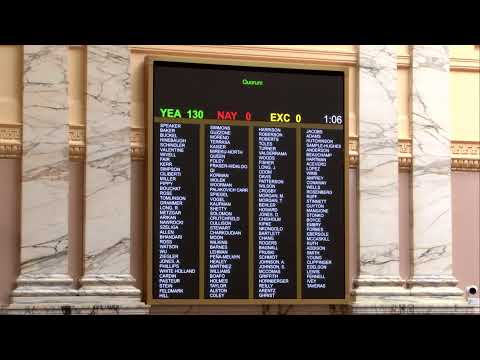
Lawmakers gave multiple practical examples on both sides: several members recounted lost thumb drives and mail delays in recent local contests, while others described constituents who depend on absentee ballots and whose votes would be disenfranchised under stricter receipt-based rules. The House ultimately recorded 95 votes in favor and 36 opposed, declaring HB 1069 passed on third reading.
What happens next: HB 1069 will be sent to the Senate (or to the governor, as applicable under cross-file rules) for final action and implementation details are expected to be refined with election officials ahead of upcoming elections.
Votes at a glance: - House Bill 1069 (third reading): Passed, yeas 95, nays 36.
Sources and evidence: Floor debate and roll call during the House floor session on March 24, 2026.