Get Full Government Meeting Transcripts, Videos, & Alerts Forever!
Get email alerts on the Agriculture Environmental Review topic
No spam. Unsubscribe anytime.
Committee lays over bill that would require EIS for livestock projects over 10,000 animal units
Summary
House File 39‑40, introduced by Vice Chair Purcell, would require an Environmental Impact Statement for livestock projects (new or expanding) exceeding 10,000 animal units. Supporters said the threshold is needed to protect water and communities; industry groups argued the number is arbitrary and existing MPCA tools suffice. The bill was laid over as amended.
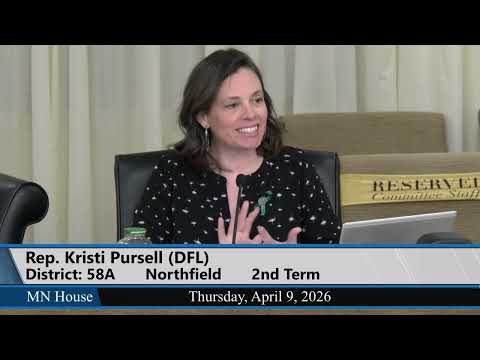
Vice Chair Purcell introduced House File 39‑40 to the House Environment Committee, proposing that any new or expanding livestock operation that reaches 10,000 animal units be required to undergo an Environmental Impact Statement (EIS) rather than the shorter Environmental Assessment Worksheet (EAW). Purcell said the scale of some proposed dairy expansions—she cited one proposal that would expand to more than 26,000 animal units—warrants a higher level of environmental review to protect drinking water, manure management and community well‑being.
Supporters told the committee the measure is intended to produce fuller, publicly available analysis. Laura Shriver, government relations director for the Land Stewardship Project, testified she supported a 10,000‑unit trigger and said an EIS would provide comprehensive assessment of environmental, economic and social impacts and identify ways to minimize harm. A farmer identifying themself as vice president of the Minnesota Farmers Union said the regulatory framework needs to keep pace with the continuing consolidation of livestock operations and highlighted concerns about groundwater, disease risk and rural economic impacts.
Industry witnesses and farm groups opposed the bill. Aaron Brown, an industry representative, told the committee that the 10,000‑animal threshold is not grounded in scientific evidence and argued that regulatory tools already available to the Minnesota Pollution Control Agency can address site‑specific risks, including the agency’s authority to require individual permits. Lucas so Strum, identified in testimony as a produce‑sector executive director, and Hunter Peterson of the Minnesota Farm Bureau Federation warned that adding an automatic EIS requirement could slow projects, raise costs and shift investment to other states.
Committee members pressed state agency witnesses on process and thresholds. Assistant Commissioner Ending of and are Bosh (MPCA) said the agency had no formal position on establishing a numeric trigger and that selecting a specific threshold would be difficult without additional data. Katherine, executive director of the Environmental Quality Board, explained that an EAW is evaluated against rule criteria and that an EIS may follow an EAW if the governmental unit determines it is warranted; she also confirmed a petition process (the committee recalled a 100‑signature threshold in‑county or in adjoining county for initiating review discussions) but noted a petition does not automatically result in an EIS.
Members also raised practical concerns about very large operations. Representatives asked who would handle animals and manure in the event of a sudden business failure; dairy producer Mr. Sellstrom testified that farm failures typically involve lenders and auction processes and are rarely an overnight surprise. Throughout the hearing witnesses debated whether the EIS threshold should be set at 10,000 animal units, whether the number was arbitrary, and how existing MPCA permitting and individual permits address water and manure management.
After discussion the committee approved a technical amendment to correct wording in the bill and laid House File 39‑40 over as amended for further consideration. Vice Chair Purcell noted the Minnesota Pollution Control Agency will hold a public meeting on the West River Dairy expansion and related permit issues on April 20 from 6:00 p.m. to 8:00 p.m. at the South Side Event Center, Reception Hall, in Morris, Minnesota.
This hearing covered testimony from industry, farm organizations, conservation groups and agency staff and ended with the bill being laid over for further work and possible revision.