Get Full Government Meeting Transcripts, Videos, & Alerts Forever!
Get email alerts on the Water And Sewer Agreement topic
No spam. Unsubscribe anytime.
Yukon residents press council for public water study and tighter limits in draft data-center water agreement
Summary
At an April 7 Yukon City Council meeting, residents and council members pressed staff about a draft water-and-sewer agreement with BLE Land Holdings, demanding a publicly available water study, clearer caps on potable and reclaimed water use, and contractual language limiting the city's obligation to find new water sources. Council approved a $299,559 hydraulic-model and SCADA study to quantify capacity.
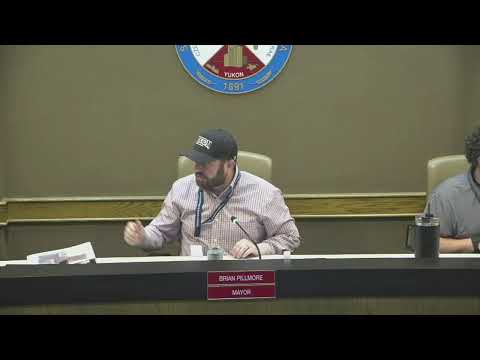
YUKON, Okla. — Residents crowded the public comment period at the April 7 Yukon City Council meeting to demand clearer technical analysis and contract limits before the city advances a draft water-and-sewer service agreement tied to development by BLE Land Holdings (BLE).
Many speakers said they had been told a formal water study would be completed before final approval but had not seen one. "I think that that water study agreement should be made public," said resident Zack Castle, who asked the city to post the analysis, daily effluent data and engineering routing plans online so citizens can review assumptions used in the contract.
Citizens and several council members questioned specific volume limits in the draft. The agreement sets maximums of 2.5 million gallons per day for reclaimed (nonpotable) water and an upper threshold of 50,000 gallons per day for potable (domestic) or "portable" water at the project site. Commenters pressed staff to write enforceable minimums and maximums into the contract and to clarify whether the agreement could obligate the city to secure additional potable sources if project needs exceed initial estimates.
"If they come back and say, 'We need more beyond the initial estimates,' is there something that gives the city the ability to pump the brakes?" asked Castle, reflecting a widely shared concern about open-ended language in clauses that allow additional improvements "without limitation."
City staff and the project manager, Nick Rice, said the city does maintain daily effluent records and internal analyses and that Garver is finishing a potable-water study that staff described as roughly 90 percent complete. Rice told the council the notice-to-proceed phase will require BLE to perform pre-engineering that will quantify final water demands and associated capital costs.
Beltline Energy representatives told the meeting they will use air-cooled systems if municipal water cannot be secured. "If we can't get water, we go air cooled. It's really that simple," said a company representative during the public comment period.
Council members and commenters also raised environmental and operational concerns: the potential impact on local aquifers (including the Garber Wellington and Canadian River alluvial sources), whether reclaimed wastewater would be suitably pre-treated before returning to the city's wastewater treatment plant, and whether the contract should impose stricter local standards than state or federal minimums for contaminants.
To give the city better technical footing, the council approved a task order with Smith Robert Baldishweiler LLC (SRB) to develop a full hydraulic model of the potable distribution system and to perform a SCADA assessment (to evaluate control systems and automation) in a contract not to exceed $299,559. The Yukon Municipal Authority and the City Council both recorded roll-call approvals for the SRB task order.
The vote to approve the SRB scope and budget carried with the members present voting yes; staff said the resulting hydraulic model and SCADA recommendations will provide pressure- and demand-based analysis that can inform any future contract thresholds, points of delivery, and infrastructure costs.
What happens next: staff committed to compiling an accessible package of the analyses (data, the Garver study, engineering assumptions and routing where possible) and to making them available to council and the public. Several residents asked that BLE representatives appear in a public forum to answer questions directly before the council takes any further contractual actions.
Council action and other business: while the water-and-sewer public discussion dominated the evening, council postponed two proposed property purchases to allow time for appraisals and approved a number of routine items including a Taylor Park fencing contract and participation in a remnant-defendant opioid settlement.
— Staff and residents requested the Garver potable-water study and SRB model be used together to determine whether proposed water commitments in the draft agreement match Yukon's available, sustainable supply. The council said it would follow up with additional public briefings and that no final contract signature was imminent.