Get Full Government Meeting Transcripts, Videos, & Alerts Forever!
Get email alerts on the Municipal Budgeting topic
No spam. Unsubscribe anytime.
Santa Barbara staff advises against November transfer-tax measure, lays out package to narrow $14.6M shortfall
Summary
City staff told the Santa Barbara City Council on April 9 that a $14.6 million FY2027 baseline deficit can be narrowed to about $3.6 million with a mix of temporary transfers, delayed hires, capital reductions and other savings; staff recommended not placing a proposed real-estate transfer tax on the November 2026 ballot because of outreach time limits and legal risk.
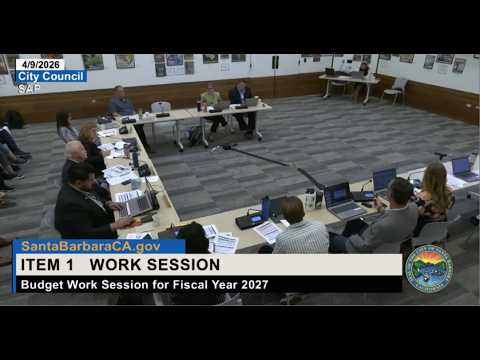
Interim Mayor Snedon convened the special meeting of the Santa Barbara City Council on April 9, where city staff presented a midyear budget update showing a structural General Fund shortfall of $14.6 million for fiscal year 2027 and a staff plan to reduce that gap to about $3.6 million.
City Administrator Kelly MS Kinney opened the presentation by framing the fiscal problem and the need for more work before the budget is finalized. "We no longer recommend that the city propose a revenue measure for the November ballot," Kinney told the council, citing tight community outreach timelines and legal and electoral uncertainties.
Finance Director Kate de Martini and budget chief Natalia Glusec laid out the numbers. De Martini said the baseline projection reflects existing policies and current service levels, then identified a mix of temporary and structural measures staff will include in the recommended budget due to be released April 21. Those measures include cutting planned capital paving by more than 50% for the next two years, delaying certain transfers, using one-time funds (including portions of opioid-settlement and parking-related revenues), delaying some fills of vacant positions and modest fee and organizational changes.
The staff package includes several specific steps: reassigning about $1.5 million in Measure I revenue to housing-related funds, a one-time proposal to transfer $2 million from the fleet replacement fund to the General Fund, and a proposed temporary change to the ordinance that fixes the utilities-users tax allocation so up to $2 million may be held in the General Fund for two years. De Martini described those measures as "mostly temporary," cautioning that the city will need structural solutions for later years.
On the proposed real-estate transfer tax staff said a feasibility survey had tested a higher-tiered tax applying to very high-value sales but that staff recommended against placing such a measure on the November 2026 ballot. De Martini noted both the compressed two-month outreach window necessary to educate voters and the risk of statewide legal or ballot challenges that could complicate local implementation: "There are possible legal challenges and a limited timeline for outreach," she said.
Public commenters urged continued investment in arts, housing and protection of city employees. Karina Sou, introduced by staff as the first commenter, said "Las artes crean comunidad, crean conexión, ellos sanan" and asked the council to keep funding public arts programs. Leo Casals, who identified himself as representing "Siu local 620," told the council that city employees and union members oppose cuts, hiring freezes and concessions that would reduce wages or benefits.
Councilmembers pressed staff for details about revenues, reserves and assumptions underlying the forecast. Staff defended the baseline methodology and explained that the 25% reserves policy (roughly three months of operating expenses) remains the council's objective even as the projected reserve ratio falls without action. Staff said the recommended package narrows the FY2027 gap to roughly $3.6 million but does not restore the policy reserve target; councilmembers repeatedly asked for a clear plan to replenish reserves if the council authorizes drawdowns.
Staff highlighted ongoing revenue opportunities and uncertainties, including the multi-year yield from the recently approved sales-tax measure (Measure I), potential impacts of a short-term-rent ordinance on transient-occupancy taxes, and the pending California appellate litigation that could affect utility-user-tax and digital-streaming tax receipts. The city also noted that opioid-settlement funds provide roughly $480,000 per year to support two joint-response positions and that enhanced parking enforcement has generated additional revenue this year.
Next steps: staff will publish the recommended budget April 21, hold budget hearings the week of May 12 and May 19, and expect council deliberations in June with an anticipated adoption on June 16. At the end of the workshop staff reported council consensus from at least four members to stop active work on the proposed transfer-tax measure for the November ballot.
The workshop produced direction rather than final votes: councilmembers asked staff to return with a recommended budget that incorporates the proposed one-time moves, clarifies operational impacts of delayed hires and capital deferrals, and specifies a plan to restore reserves if any drawdown is approved.