Get Full Government Meeting Transcripts, Videos, & Alerts Forever!
Get email alerts on the County Budget topic
No spam. Unsubscribe anytime.
Karolina Herren outlines platform: opposes commissioner pay hikes, vows tax restraint and greater transparency
Summary
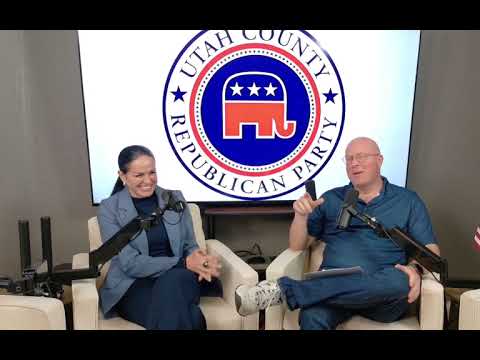
In a Utah County Republican Party podcast interview, commissioner candidate Karolina Herren said she opposes recent pay increases for elected officials, pledged not to support property-tax hikes in her first term, and proposed more transparent budgeting and office hours to improve accountability.
Karolina Herren, a candidate for Utah County Commissioner Seat B, told a party podcast audience that she opposes recent increases in elected-official pay and would not support raising property taxes during her first term.
Herren, who serves as legislative affairs director for the Utah Department of Corrections and previously worked as a senior policy adviser in the county commission office, said the roughly $170,800 annual pay for commissioners is “extreme” and that pay levels should be reevaluated after examining what commissioners are actually expected to do. “I do not agree with that,” she said of the raises, adding, “I will not support a salary increase or an increase for elected officials.”
Why it matters: Commissioners set the county budget and make long-term financial commitments. Herren said the commission should prioritize cutting unnecessary spending and reviewing department roles before asking voters for more revenue. “We need to stop unnecessary spending first,” she said, noting that public-safety and constitutionally mandated services should be protected.
On property taxes, the host noted prior county increases — about 67% in 2019 and about 48% in 2024 — and asked whether taxes are too high. Herren answered that further increases would be inappropriate without a thorough budget review. “I do not believe that that would be necessary,” she said, adding she would talk with elected officials and use working groups to identify cuts and efficiencies.
Herren defended scrutiny of commission-office staffing and the use of grant-funded positions. Asked whether the commission staff expansion was appropriate, she said many positions are paid from grants and would end if the grants lapse, but conceded that some roles deserve review: “If the grant went away, then the position would go away,” she said, while adding, “I know that that's something that's coming up a lot that people are concerned about.”
On governing structure, Herren said she supports placing proposals to expand or restructure the county commission on the ballot rather than unilaterally adopting a mayor–council model. She said she would accept reductions in pay to enable an expanded commission and that commissioners should be prepared to serve full time. “I'm 110% supportive of putting it on the ballot and letting people decide if that's what we need to do,” she said.
Public safety and immigration: Herren expressed strong support for the county’s 287(g) agreement with U.S. Immigration and Customs Enforcement and said she has worked with ICE and the Department of Homeland Security. “I’m very supportive of ICE,” she said, and emphasized that she supports legal immigration via established processes and “will support ICE and legal immigration by legal means.”
Budget process and transparency: Herren endorsed a zero-based approach to budgeting — starting from basic, constitutionally mandated needs and then evaluating additional requests — and criticized accepting the auditor-produced tentative budget without rigorous review. She also proposed concrete transparency measures if elected: a monthly newsletter paid from her own funds, twice-monthly open office hours, satellite office hours across the county, and trying one evening commission meeting each month to let more residents participate.
Transportation, water and development: Herren said she would press county representatives to secure a fair return on regional transportation dollars (quarter-cent sales taxes and Mountainland Association of Governments allocations), questioned the benefits of further BRT-style projects unless they meet clear local needs, and praised FrontRunner commuter rail ridership. On water, she highlighted Utah Lake Authority efforts and federal grants for lake cleanup (noting a recent federal award of just over $7 million discussed in the interview) while saying long-term water solutions require partnerships with agricultural stakeholders.
On redevelopment financing, Herren said she would oppose county participation in redevelopment agencies (RDAs) and tax-increment financing (TIF) deals, arguing the county should not take on tax breaks that shift long-term burdens without adequate oversight, though she acknowledged some city-level deals may be locally warranted.
Herren closed the interview by urging constituents to engage: she spelled out campaign contact information (website voteherrin.com; email voteherrin@gmail.com; phone 385218970) and invited residents to office hours and conversations. “You are my boss,” she said, describing how voters should hold elected officials accountable.
The interview does not record any formal votes or official actions; Herren’s statements represent her campaign positions ahead of the election.