Get Full Government Meeting Transcripts, Videos, & Alerts Forever!
Get email alerts on the Military Medical Readiness topic
No spam. Unsubscribe anytime.
Panel: Lessons from Ukraine’s front lines show gaps in U.S. military medical readiness
Summary
At a Hinckley Institute forum, senior military and civilian trauma surgeons said Ukraine’s drone-driven, trench-style fighting has produced mass casualties and prolonged evacuation times, and urged the U.S. to send medical observers, update doctrine, train medics for prolonged care and invest in forward blood capability and new technologies.
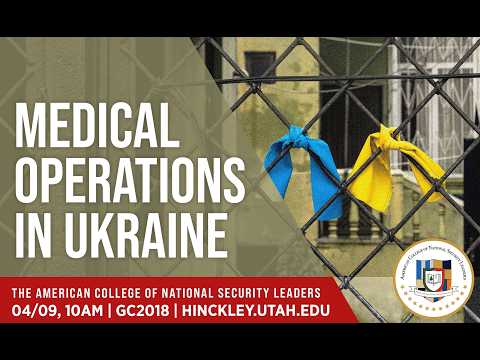
SALT LAKE CITY — Senior military and civilian trauma surgeons at a Hinckley Institute forum urged U.S. military and medical leaders to treat battlefield medicine in Ukraine as a policy and training priority, arguing that drones, mass-casualty numbers and targeted medical facilities have created prolonged-care challenges not seen in recent U.S. wars.
Lieutenant General Ronald Ray Blank, who moderated the panel, introduced the discussion by asking how two decades of U.S. combat medical advances compare with the demands of the Ukraine conflict. "How do drones, vintage weapons, novel weapons require a shift in our approach to medical care?" he asked.
Dr. Jeremy Cannon, professor of surgery at the University of Pennsylvania and a retired U.S. Air Force colonel, said the contrast is stark. He told the audience that improvements developed during the Iraq and Afghanistan campaigns — rapid evacuation, tourniquet use and forward blood resupply — produced "battlefield medical supremacy" in those theaters. In Ukraine, he said, casualty numbers resemble World War II levels, evacuation is often impossible under drone and artillery fire, and medical teams have been forced underground.
"One in four of our combat deaths over the past century could have been prevented if our system had been more prepared," Cannon said, arguing that the United States risks returning to avoidable deaths unless it learns from current combat conditions. He urged sending medical observers to collect frontline data and recommended that U.S. institutions test new technologies and integrate data tracking so records follow a casualty through all phases of care.
Dr. Matthew Bradley, professor and chair of surgery at Uniformed Services University, said the decisive change on the battlefield is prolonged casualty care: "You can't evacuate right away. So the question is how do you do that prolonged casualty care and who does it?"
Bradley and other panelists recommended expanding training for medics and general medical officers to provide extended field care, and exploring AI-assisted tools and robotic aids for hemorrhage control at the point of injury. He also warned that traditional walking blood banks and forward blood resupply may be unreliable in large-scale combat operations, and urged investment in forward whole-blood capability and research into blood-product substitutes.
Dr. Tom Thomas, dean of the Eastern Campus at West Virginia University Health Science Center and a retired major general who has volunteered in Ukraine, described volunteers' contributions and risks. He said volunteers helped train underprepared frontline medics, provided individual first-aid kits and helped move supplies — but that volunteers and hospitals were often targeted, creating command-and-control complications.
"They deliberately target hospitals," Thomas said, describing strikes on facilities he observed. He added that volunteers expand capacity but can be wounded or killed and that unclear lines between civilian and military medical leadership in Ukraine complicated coordination.
Panelists repeatedly called for action: deploy medical observers to gather direct operational data from Ukrainian hospitals and front lines; codify lessons into doctrine quickly; expand training for medics and non-surgeon physicians to manage prolonged care; and accelerate fielding of technologies that aid hemorrhage control, blood management and remote monitoring.
Audience members raised practical questions about equipment and doctrine. A service member asked how individual first-aid kit contents and training should change for large-scale combat operations; speakers recommended updating IFAK contents, teaching "tourniquet conversion" (reassessment and relocation once the casualty reaches cover) and prioritizing forward whole-blood solutions.
The panel closed with a reminder that medical consequences extend beyond immediate survival. "There's a whole society that is going to have significant post-traumatic stress and all the consequences thereof," Moderator Blank said, urging planners to consider both acute and long-term care needs.
Next steps from the forum included urging professional societies and academic centers to compile direct frontline data from Ukraine, produce operational guidance for prolonged casualty care, and brief policymakers on readiness gaps that require funding or policy change.