Get Full Government Meeting Transcripts, Videos, & Alerts Forever!
Get email alerts on the Fire Department Staffing topic
No spam. Unsubscribe anytime.
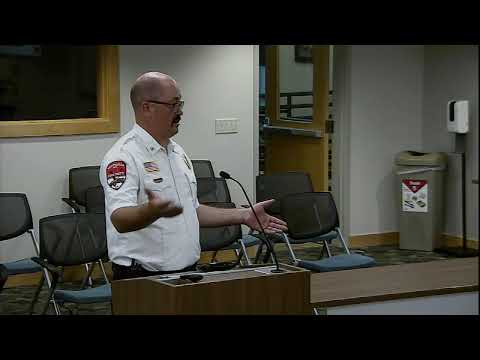
Fire Chief proposes scheduled 'duty crew' paid-on-call role to reduce cancelled shifts and speed responses
Summary
Fire Chief Dave Shoger told the Victoria City Council workshop the department will pilot a scheduled paid-on-call "duty crew" role — roughly 60 hours per quarter — to reduce cancelled shifts, improve response times (5:15 vs. 7:43) and absorb rising call volumes; council expressed support and directed staff to carry the plan forward.
Fire Chief Dave Shoger told the Victoria City Council workshop that the department will propose a primarily scheduled paid-on-call "duty crew" role to reduce recently canceled duty shifts and improve response times.
Shoger said quarter three saw an unusual number of canceled duty-crew shifts given the department’s current staffing, which he described as "27 firefighters and three full-time firefighters." He told council that under the existing model paid-on-call firefighters must complete 20 scheduled duty hours per quarter and also respond to roughly 25% of all-call responses; the new role would schedule roughly 60 hours a quarter and not carry the 25% all-call response obligation.
Shoger framed the change as an operational reallocation rather than an increase in total headcount, saying the department hopes to convert some current members and to onboard two to three hires from the current recruitment process. "We're looking to make available two to four shifts of new firefighters or current firefighters that would like to transition to what we call a duty-crew firefighter," he said.
Shoger cited response-time data to justify the model, saying duty-crew shifts average 5 minutes, 15 seconds from page to apparatus on scene compared with 7 minutes, 43 seconds under all-call operation — a roughly two-and-a-half-minute difference he said improves service. He also said year-to-date call volume was "like 470 to 500 calls somewhere there this year," up from about 410 calls in 2024, and argued that demographic trends and potential memory-care facilities would increase future demand.
Council members asked operational questions about how duty-crew paging interacts with the all-call system. Shoger explained dispatch uses distinct page tones so a staffed duty crew receives a specific notification; if calls overlap, the event is upgraded to an all-call so additional responders are alerted.
Mayor and council members broadly voiced support for the approach, citing predictability for personnel and efficiency gains. The council did not take a formal vote on the staffing model at the workshop but indicated staff "has the information they need" to carry the proposal forward for implementation planning.
The workshop ended with a motion to adjourn that was seconded and approved by voice vote. No ordinance, budget appropriation or personnel action was adopted during the meeting; further implementation steps and staffing details were left to staff to develop and return to council for any required approvals.