Get Full Government Meeting Transcripts, Videos, & Alerts Forever!
Get email alerts on the Master Plan And Zoning topic
No spam. Unsubscribe anytime.
Plymouth planning board outlines 2026 priorities: master plan work, short-term rentals and RV rules
Summary
The board set priorities for 2026 including restarting a master-plan rewrite (CIP funding proposed), updating subdivision/site-plan procedures, and reviewing short-term rental and RV/tent rules after a resident letter urged clarification and enforcement changes.
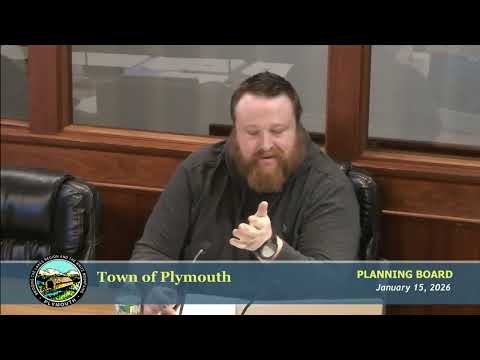
At its Jan. 22 meeting, the Plymouth Planning Board sketched its priorities for 2026, agreeing to pursue a combination of regulatory updates, planning studies and inter-board coordination.
Members signaled a near-term focus on rewriting out-of-date subdivision regulations and preparing for a master-plan refresh. Joseph told the board the CIP currently proposes $10,000 in a capital-reserve account this year and a $50,000 request the following year to support a full master-plan rewrite; staff said the housing chapter funded by the HOP grant will be an early input to the larger project. "We have $10,000 if our budget is approved for this year," Joseph said while outlining the CIP proposal.
The board also prioritized clarifying administrative procedures — for example, specifying when an engineering assessment should be required up front for complex projects — and updating references that are out of compliance with state RSA changes dating to 2002 in the current regs.
A recent communication from Tom Nukem prompted a detailed discussion of short-term rentals and recreational-vehicle use. Staff recited the town’s zoning provision (section 403.3), which allows a property owner to accommodate up to two non-paying guests in no more than two recreational vehicles or tents for up to 120 days per calendar year if sanitary facilities are available. Board members noted enforcement challenges with a 120-day limit and discussed potential time-window approaches, building-permit exceptions and how more formal short-term-rental regulation at the state level might change local approaches. "120 days is hard to enforce," one member said, and the board instructed staff to prioritize the two requests Tom submitted for follow-up work.
Members also agreed to strengthen coordination with other local boards — including conservation and energy commissions — to align trail connectivity, wildlife-corridor planning and economic-development inputs to the master plan. The Board asked staff to collect statutory compliance items and common waiver patterns to better target the rewrite.
Next steps: staff will compile compliance issues and waiver data, continue work on subdivision-regulation templates, and monitor CIP/budget decisions that would fund a consultant for the master-plan rewrite. The board will hold a housing-chapter community meeting on March 2 to gather public input.