Get Full Government Meeting Transcripts, Videos, & Alerts Forever!
Get email alerts on the Humanitarian Aid topic
No spam. Unsubscribe anytime.
UN coordinator warns of heavy civilian toll in Lebanon as air strikes surge; $308M flash appeal far short
Summary
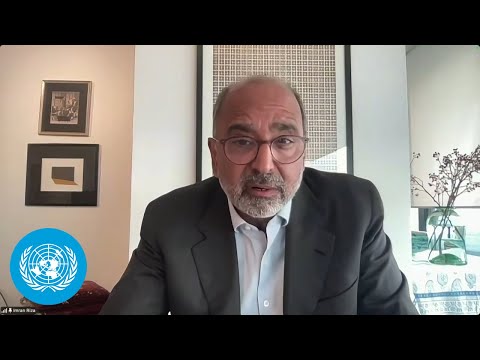
Imran Riza, the UN resident and humanitarian coordinator in Lebanon, told reporters from Beirut that recent air strikes have caused large numbers of civilian casualties, overwhelmed hospitals and driven nearly 1.2 million people from their homes; he said a $308 million flash appeal is only about one-third funded and urgently needs more donor support.
Imran Riza, the United Nations resident and humanitarian coordinator in Lebanon, said from Beirut that a fresh wave of air strikes has inflicted ‘‘a huge civilian tragedy’’ across Lebanon, leaving hospitals overwhelmed and driving unprecedented displacement.
"We woke up today this morning to news obviously of the ceasefire...and then somehow, the events of today have been dramatically...different," Riza said, describing hours of explosions and ambulances sweeping through Beirut. He cited Ministry of Public Health figures that put the death toll since the March escalation at about 1,530 people, including roughly 130 children, and said 461 children have been injured.
Riza said displacement has reached "some close to 1.2 million," roughly one in five people in Lebanon, with 138,000 sheltering in 678 collective sites (mostly schools) and more than 800,000 dispersed across host communities or informal settings. He added that an estimated 110,000–140,000 people in the south have either chosen to remain or are effectively trapped.
The coordinator warned that damage to essential services has worsened the humanitarian emergency. "The pressure on the health system...is not just simply because of the years of decay," he said, adding that the UN had recorded more than 106 incidents against health care that resulted in 57 deaths and 158 injuries among health workers. At least 51 health centers and six hospitals had closed or been damaged, he said.
Education has also been disrupted, Riza said, with public schools and the Lebanese University used as shelters and remote learning constrained by displacement and power outages. He said the disruption will have long-term effects on children, especially girls and those with disabilities.
Riza outlined a funding shortfall that is constraining response operations. "We launched a flash appeal for 308 million dollars on the 13th of March...that 308 million is only about a third funded at this point," he told reporters, adding that the appeal was being revised to reflect rising needs. He urged swift donor support, noting that stocks of supplies are far lower than in 2024 and that the logistical cost of getting aid to those in need has increased.
On access to affected areas, Riza said border and road routes are endangered. He said the Masna crossing between Lebanon and Syria was closed after threats and remains shut, though ‘‘there has been a great deal of advocacy...to try to keep it open’’ and it might reopen soon. "At the moment, in terms of humanitarian assistance, the majority of it comes by sea or by air. Very little is coming by road," he said, noting convoys from Dubai and Jordan that have reached Lebanon despite delays.
Reporters asked about the prospects for people returning to the south if a ceasefire held. Riza said damage to villages and public pronouncements had made many displaced people reluctant to return. "They're worried about where do they go back to?" he said, citing examples of destroyed civilian homes in towns such as Naqoura and warning that the situation looks unlikely to allow mass returns in the near term.
Riza emphasized three central messages: an urgent need for de-escalation and dialogue, strict respect for international humanitarian law to protect civilians and humanitarian personnel, and significantly increased funding and unimpeded access to deliver aid. "De-escalation and dialogue are urgently needed to prevent further suffering," he said.
During a question-and-answer session, reporters pressed on logistics, protection and capacity. Riza described ongoing daily coordination with the government, municipal leaders and disaster management authorities, and highlighted the role of UN agencies (including WFP, UNICEF and UNHCR), the Lebanese Red Cross, Caritas and other NGOs conducting convoys and relief operations on the ground.
He said the UN teams were remaining in Lebanon to "stay and deliver," but reiterated that the response depends on resources and access. "The strategy as well as the resources," he said, "The majority of people right now are not in shelters...one of the best ways to be able to assist them...is actually cash assistance. So, the Ministry of Social Affairs has a social welfare cash program that needs support."
Riza repeatedly called on member states and donors to press parties to respect humanitarian law and to provide the funding required to respond. The briefing concluded with thanks to Riza and an appeal for more international attention and rapid donor support to meet escalating humanitarian needs.
The UN said the flash appeal is being revised; Riza and his teams continue to coordinate with Lebanese authorities and humanitarian partners while urging de-escalation, stronger protection for civilians and immediate funding increases.