Get Full Government Meeting Transcripts, Videos, & Alerts Forever!
Get email alerts on the Social Media Children topic
No spam. Unsubscribe anytime.
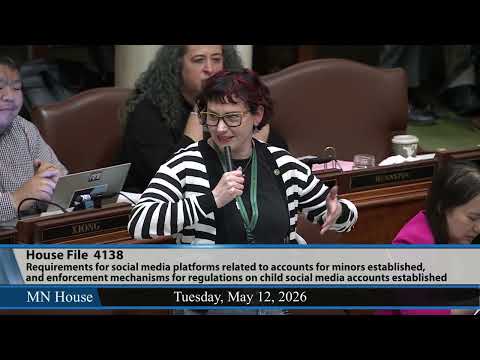
Minn. House passes bill limiting addictive social-media features for children, 132-2
Summary
The Minnesota House on May 12 approved House File 4138 as amended, banning specified addictive features for accounts identified as belonging to children and adding parental-consent and privacy safeguards; supporters hailed it as a first step, opponents warned of gaps and possible litigation.
The Minnesota House passed House File 4138 as amended on May 12, approving a measure aimed at reducing social-media harms for children.
Sponsor Representative Scott urged lawmakers to vote for the bill, saying it will require platforms to provide high-privacy default settings for child accounts and remove addictive functions such as infinite scrolling, autoplay video and visible engagement metrics for users the platforms identify as under age 16. “This bill is going to do a lot to protect our kids,” Scott said on the floor.
Supporters described the law as a bipartisan first step. Representative Bonner, who withdrew a technical amendment earlier in the debate, called the bill “a big, big start” and urged the authors to continue refining language to reduce legal exposure. Representative Robbins, who said she has worked on this issue for six years, praised the measure’s default privacy protections and its limits on recommendation and publishing features.
Opponents and cautious supporters pressed the authors on limits of the proposal. Representative Liebling asked why the bill relies on parental consent rather than prohibiting addictive features for all minor accounts; Scott replied that policymakers chose parental involvement to empower caregivers and to give parents a role in account verification. Liebling warned that some parents may authorize settings without fully understanding terms of service and that the bill therefore may not protect every child.
Representative Greenman and Representative Smith both pointed to unanswered questions about location-based coverage and the decision to exclude some older teenagers; Greenman said the chamber had been unable to include a cross-cutting reference to weapons imagery in a threat-reporting amendment because of pushback during floor consideration. Representative Bonner recounted several tragic cases to argue for raising the covered age to 18 in future revisions.
The House adopted the underlying Smith amendment as amended on a roll call, then the full bill passed on third reading by a count of 132 yeas and 2 nays. The bill requires platforms to make child accounts private by default, to remove or disable specified engaging features for accounts identified as belonging to children under 16, and to include clearer parental-consent and verification steps. The bill also includes a private right of action tied to knowingly maintaining addictive features for children.
Next steps: the bill will move to the Senate for consideration.