Get Full Government Meeting Transcripts, Videos, & Alerts Forever!
Get email alerts on the Artificial Intelligence Policy topic
No spam. Unsubscribe anytime.
Senate Commerce Subcommittee Hears Industry Case for Worker‑Centered AI, More Data Access and Standards
Summary
Industry witnesses told a Senate Commerce subcommittee that AI can boost manufacturing and healthcare productivity while augmenting—not replacing—workers, and urged more machine‑readable government data, stronger life‑cycle governance, and standards to ensure safety and equitable adoption.
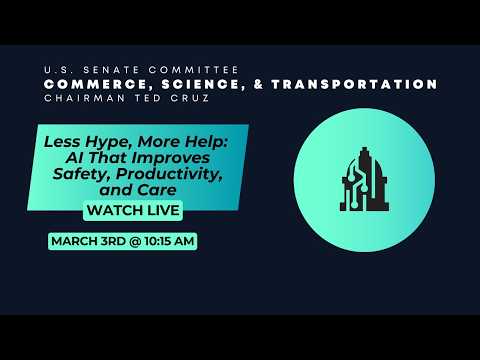
A Senate Commerce subcommittee hearing on artificial intelligence featured industry witnesses who urged lawmakers to pair rapid AI deployment with stronger data access, worker‑centered design and national standards.
"AI is most powerful not when it replaces human judgment, but when it strengthens it," said Yanni Copalis, chief innovation officer at Rad AI, testifying about radiology tools that flag urgent findings and help clinicians prioritize care. Copalis told the committee that timely, validated AI could reduce diagnostic delays that, he said citing Johns Hopkins research, contribute to roughly 800,000 deaths or permanent disabilities annually from diagnostic error.
Britney, vice president at Seammens, described industrial deployments on factory and shipyard floors and offered concrete performance claims: she said her company invested about $15 billion in the United States and cited outcomes such as a 50% reduction in machine downtime, 20% less energy use and productivity improvements of up to 40% where industrial AI and digital twins are in place. "Digital capability is core industrial infrastructure," she told senators, urging public‑private programs and workforce training to scale adoption.
Dr. Damian Shelton, co‑founder and chairman of Agility Robotics, emphasized safety and staged deployment for robots in shared workspaces. He pointed to both the opportunity to expand hiring and the need for rigorous safety testing, warning that rapid advances abroad—he cited vulnerabilities researchers reported in some Chinese humanoid robots—warrant attention to security and supply‑chain risks.
Mark Muro of the Brookings Institution told the committee that sustaining U.S. leadership will require continued investment in basic AI research, regional testbeds and talent pipelines. He urged Congress to revive AI research institutes and support regional clusters that pair hyperscalers, universities and workforce programs.
Committee members pressed witnesses on three cross‑cutting issues:
- Data access and validation: Witnesses said more machine‑readable federal datasets, and domain‑specific longitudinal datasets for fields such as radiology, would accelerate developers’ ability to validate tools against real‑world outcomes. Copalis stressed that appropriate deidentification and outcome linkage are essential for clinical validation.
- Workforce and training: Senators raised concerns about job displacement; panelists responded that AI tends to reshape tasks and increase demand for higher‑skill roles if workers are reskilled. Seammens described plans for micro‑credentials and training 200,000 electricians and manufacturing specialists by 2030 to support modern production jobs.
- Standards, transparency and testing: Several senators asked about independent evaluation and guardrails. Witnesses described clinical partnerships, third‑party evaluation concepts (the Vet AI Act was mentioned by a senator) and industry practices such as sharing source operational data and explainability in industrial settings to build trust.
Lawmakers also explored AI‑accelerated discovery in laboratories, with witnesses saying autonomous experimental platforms and AI models like AlphaFold illustrate how computation plus lab automation can compress months‑to‑years research cycles, strengthening arguments for sustained funding of scientific institutions and aligned compute and data resources.
The subcommittee did not adopt legislation at the hearing. Senators set deadlines for written questions (to be submitted by March 10) and for witnesses’ written responses (by March 24). The hearing record will be used to inform forthcoming legislative discussions about federal standards, data policies and workforce programs.
The hearing showcased broad agreement on technology's potential and sharp differences over what policy moves—data sharing rules, independent testing, apprenticeship expansion, or export controls—should come first. Senators and witnesses left a clear signal: Congress faces near‑term choices about how to accelerate adoption while protecting safety, security and worker opportunity.