Get Full Government Meeting Transcripts, Videos, & Alerts Forever!
Get email alerts on the Airport Capacity topic
No spam. Unsubscribe anytime.
Greater Orlando Aviation Authority details parking, terminal and rail plans as airport demand climbs
Summary
GOAA officials told the TransMAC on April 9 that Orlando International and Orlando Executive airports face capacity and parking strain; the authority outlined near‑term fixes (parking guidance, Terminal C bridge, eight additional gate positions) and longer‑term master‑plan work including rail corridors, baggage modernization and 8,000 new parking spaces through 2030.
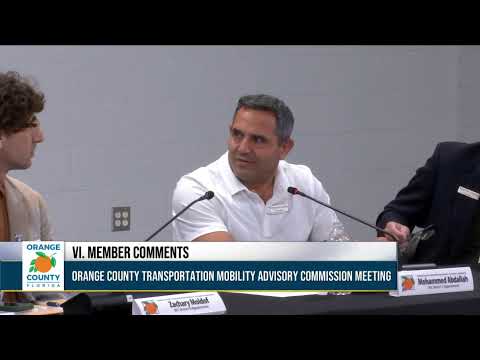
Brad F., senior vice president for planning and environmental affairs at the Greater Orlando Aviation Authority, told the Transportation Mobility Advisory Commission on April 9 that Orlando International Airport (MCO) and Orlando Executive Airport (ORL) face mounting capacity pressures as passenger and operations growth outpaces facilities.
Brad said MCO handles roughly 57 million annual passengers today and operates on an airport footprint exceeding 11,000 acres with four runways and 121 gates. He described three main near‑term capacity challenges: constrained parking, an over‑taxed baggage system in Terminals A/B, and long walking distances within terminals that stress passenger circulation.
The authority’s immediate tactical responses include installing a parking guidance system across the garages (terminal C first, A and B to follow), a recently opened pedestrian bridge connecting the train station to Terminal C to reduce curb‑side walking, and an eight‑gate expansion at Terminal C (configured to accommodate eight narrow‑body positions). GOAA told the commission it plans to add about 8,000 structured parking spaces by 2030 to address a current shortfall and to reconfigure rental‑car ticketing and operations while reevaluating the earlier consolidated rental‑car (CONRAC) concept.
Brad and Chris Delisha, GOAA’s senior landside planner, characterized longer‑range planning as a mix of capital improvements and technology. GOAA is pursuing a global design competition to replace and modernize the baggage handling system; studying airside expansions (including a proposed Airside 2 wing and nine additional gates in later phases); and examining passenger conveyance solutions such as moving sidewalks, automated people movers (APMs) and biometric processing to raise throughput without building entirely new terminals.
The authority also emphasized multimodal corridors it has preserved for Brightline, SunRail and potential future light rail, and said it is coordinating with CFX and FDOT on roadway access and wayfinding. GOAA described an integrated corridor management approach and a traffic model to evaluate operational changes—such as relocating ridesourcing pick‑up/drop‑off zones—and the authority said it is exploring advanced air mobility test corridors in partnership with FDOT and the FAA.
Commissioners asked how travelers reach MCO. GOAA provided a modal breakdown for passengers and employees in response: about 28% of passengers currently use ridesourcing services (Uber/Lyft); approximately 30% use rental cars; roughly 60% of passengers come by car overall; employee commutes are heavily auto‑dependent (about 84% drive alone, with small shares using Lynx, Brightline/SunRail or active modes). GOAA said those modal splits drove its near‑term parking and rental‑car strategies.
Brad cautioned that federal grant assurances limit how airport revenues may be spent: money derived from airport operations generally cannot be used for off‑airport roadway projects. He said the authority seeks to maximize on‑airport revenue (parking, rental‑car fees, concessions) to fund capital projects and emphasized continued coordination with local and regional agencies on access and shared corridor planning.
The commission and GOAA agreed to follow up with staff‑level briefings on revenue flows, rental‑car economics and options for shifting curbside operations to reduce central congestion. GOAA offered to provide materials and additional data to the commission and said it will pursue interagency studies to deconflict multimodal access in the south corridor near Terminal C.