Get Full Government Meeting Transcripts, Videos, & Alerts Forever!
Get email alerts on the Health Programs topic
No spam. Unsubscribe anytime.
Finance committee tables $1.2M Pathways to Wellness research request, seeks E-Hack review
Summary
The Finance & Budget Committee heard a presentation on Pathways to Wellness — a community hypertension program and randomized study — and voted to table funding until May 6 to allow the Evston Health Advisory Council (E-Hack) to review the budget and protocols.
The Finance & Budget Committee on April 8 heard a detailed presentation on Pathways to Wellness, a community-based program designed to reduce the city’s racial life-expectancy gap by screening for hypertension, offering lifestyle supports and testing a clinical medication-management intervention in the community. Committee members voted to table the item until the May 6 meeting so the Evston Health Advisory Council (E-Hack) can review budget and protocol questions.
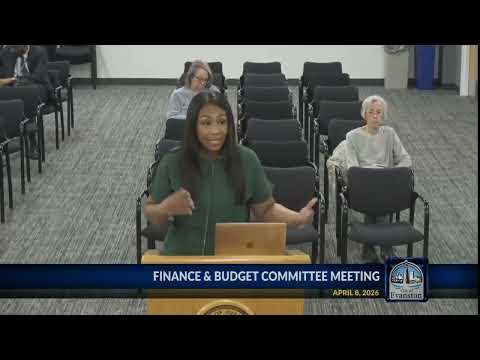
Natisha Waldron, the program designer, told the committee the initiative began from local e-plan data showing a 13-year life-expectancy gap and that an initial ARPA allocation of $400,000 had supported design work. “We have been more than responsible,” she said, noting roughly $344,000 remained from the prior allocation and that the long-term operational cost could be reduced to under $75,000 a year once the research phase is completed and insurance coverage handled. She said the program’s design includes community blood-pressure screening, lifestyle support and a randomized clinical arm that brings nurse-practitioner medication management into community settings.
Dr. Beth Lynch of Rush University, the project’s lead investigator, presented evidence that uncontrolled hypertension largely drives the life-expectancy gap and explained the study design: community screening, a lifestyle-support component for all participants, then randomization to either enhanced community clinical management or usual-care referral to primary care. She summarized expected data collection points and said high-quality research can generate peer-reviewed results that make future funding and grant applications easier.
Committee members pressed on three issues: why another randomized study is needed when prior interventions exist; the program’s sustainability cost; and how medication and uninsured residents’ needs would be covered. Dr. Lynch said the team combined components from past work and adapted them to local gaps — for example, pairing clinical care with community trust-building — and argued that rigorous, local evaluation is necessary to ensure the model works across genders and in Evston’s context. Presenters said medication costs are not included in the research budget; insured participants would use insurance and the project would seek grants or a targeted subsidy for uninsured residents.
Director Ogbo of the city’s health department told the committee the project aligns with the city’s e-plan but recommended that E-Hack review the project’s budget items and protocols before council action. The committee voted to table the funding request until May 6 to allow that advisory review. The motion to table FB1 was moved by Council Member Nusma and seconded by Dr. McGuire; the roll call vote recorded six in favor and none opposed. The committee requested that E-Hack meet with the Pathways team before the item returns to the committee.
Next procedural steps: the committee will consider comments from E-Hack and the program team at its May 6 meeting before making a funding recommendation to full council.