Get Full Government Meeting Transcripts, Videos, & Alerts Forever!
Get email alerts on the Education Finance topic
No spam. Unsubscribe anytime.
Committee hears proposal to raise Minnesota teacher pay and create statewide educator health-insurance pool
Summary
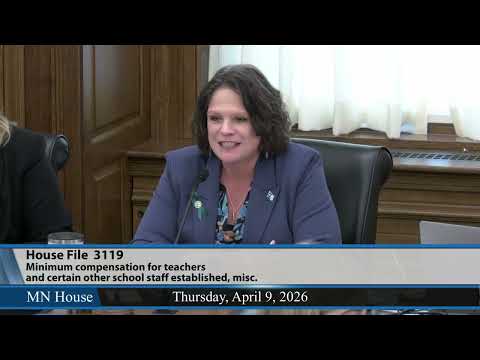
The House Education Finance Committee on April 9 considered House File 3119, which would set minimum base pay for licensed teachers and require data collection to enable a statewide educator group insurance pool. Educators and advocates testified about low pay, rising premiums and how a pooled plan could stabilize costs.
Representative Mary Sense, the bill sponsor, told the House Education Finance Committee that Minnesota must address both pay and health coverage to retain educators. "We are asking people who hold college degrees ... to accept a roughly one-third pay cut in exchange for the privilege of educating Minnesota's children," she said, urging the committee to support an amendment to House File 3119 that sets minimum base salaries and requires districts to report health-insurance data.
The amendment spelled out salary floors and a data step intended to prepare for a statewide pool. Sense described proposed salary thresholds beginning in 2026–27, including a $60,000 minimum for teachers with a bachelor’s degree, higher levels for master’s-degree holders and an indexed mechanism so the floor would not erode with inflation. She said the bill would also require every district and charter to complete an annual survey of premiums, broker fees and plan design so the Legislative Budget Office could prepare a fiscal note for a potential statewide program.
Supporters and service-provider witnesses told the committee the two-part approach responds to an affordability crisis. A presenter from the Teacher Salary Project summarized national research finding that Minnesota teachers take home roughly 33% less than comparable workers, and that low pay and long hours are top reasons teachers leave the profession.
"When teacher pay had kept pace, it would be $120,000," the presenter said, describing historical declines in relative pay and noting that other states and countries that tie teacher pay to comparable professions show stronger recruitment and retention.
Multiple educators gave personal testimony about rising premiums and out-of-pocket costs. Counselor Breanna Lawrence described the strain of family medical bills and current premiums: "Right now my husband and I pay $686 in monthly health care premiums. The most inexpensive family plan for our district would cost us $2,232 per month," she said, adding that a realistic high-deductible family option would cost $1,464 per month.
Representatives of Education Minnesota and other advocacy groups supported both pay floors and a pooled insurance model. John Lowe, president of Education Minnesota, said districts that were self-insured are now facing double-digit premium increases and tightened coverage, making it hard for any single district to withstand a high-cost claim. "We support combining our resources and efforts on a large scale in a statewide plan," he told the committee.
Policy and fiscal staff briefed members on current district spending and on what the amendment's reporting requirement would collect. Mr. Strachan explained that, on the employer side, districts paid roughly $1.2 billion in FY25 for health-insurance premiums and additional sums for tax-advantaged health accounts and dental; he noted the available data show a per-enrollee employer average of about $1,430 but that employee-share data are not compiled statewide today.
Committee members asked technical and policy questions about scope and local authority. Members pressed whether the proposal would supersede local bargaining or create a de facto statewide school board; sponsors said the bill sets a statewide floor for wages and minimum premium contributions while leaving collective bargaining intact for compensation above that floor. Questions also focused on who would be covered, how state aid would interact with existing district employer contributions, and whether salary increases should be phased in over several years.
Representatives voiced a mix of support and caution: some called the proposal a necessary step to stabilize the educator pipeline, while others warned about long-term funding sustainability and urged more analysis before committing to permanent changes.
At the end of the hearing the committee voted to lay over House File 3119 as amended for further consideration. No final appropriation or binding decision was made; the bill will return for additional fiscal analysis and potential future hearings.
The committee record includes detailed personal testimony, technical briefings and questions that lawmakers said they will use to refine the bill and to develop a comprehensive fiscal note before any final votes.