Get Full Government Meeting Transcripts, Videos, & Alerts Forever!
Get email alerts on the Ndas Transparency topic
No spam. Unsubscribe anytime.
Committee deadlocks on bill to ban municipal nondisclosure agreements
Summary
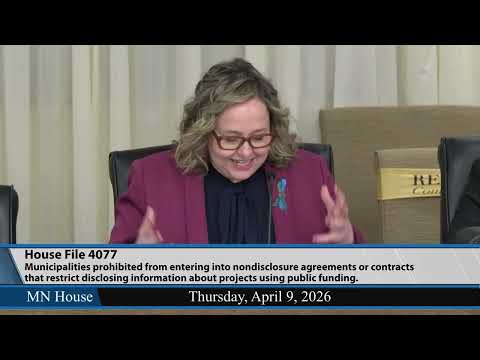
After hours of testimony from local officials, residents and business groups, the House Judiciary Finance Committee deadlocked 7–7 on House File 4077, a bipartisan proposal to bar municipalities from entering NDAs that hide land development or government-funded projects from the public.
House File 4077, a bipartisan bill that would prohibit local governments from using nondisclosure agreements to conceal land-development, economic-development or government-funded projects, failed to advance out of the House Judiciary Finance Committee on April 9 after a 7–7 tie vote.
Representative Greenman, the bill's author, told the committee the bill was narrowly tailored to prevent municipalities from using NDAs to “circumvent Chapter 13” of Minnesota law and to ensure citizens know when their local governments are making decisions that affect neighborhoods and taxes. Representative Roach urged colleagues to vote yes, saying, “This bill protects taxpayers and restores trust within the community.”
Supporters included local elected officials who described recent experience with data center proposals. Ashley Graham, St. Louis County commissioner for the 3rd District, told the committee she had not seen “anything erode trust as quickly or as badly as when commissioners signed NDAs last year,” and said NDAs delayed public engagement while companies developed projects. Tom Berg, a mayor, and several residents from Farmington and Hermantown described projects they said moved through early planning behind closed doors with limited public notice.
Business groups urged caution. Jonathan Cotter of the Minnesota Chamber of Commerce said HF 4077 would “inhibit economic development” by removing a confidentiality tool companies and municipalities commonly use in early-stage site selection and deal structuring. Dalton Danielson of the Minnesota Business Partnership warned the bill was broader than intended and could deter investment across sectors, not only data centers.
Members traded sharply different views on whether existing law already protects trade secrets. Representative Feist, co-chair of the Commission on Data Practices, described the four-part test in the Data Practices Act that protects trade secrets and reiterated that government contracts may not contract out of Chapter 13 protections. Other members said the problem was not the statute’s language but local practice and delays: they argued citizens often learn about projects only after key decisions have been made, and they supported a statutory fix.
A motion to re-refer the bill to the General Register was put to a roll call; the motion failed on a 7–7 vote, so HF 4077 did not advance. The committee record shows broad testimony but no amended language adopted in this hearing; proponents and opponents indicated they are open to further drafting and discussion.
The committee moved on to other agenda items after the vote.