Get Full Government Meeting Transcripts, Videos, & Alerts Forever!
Get email alerts on the Ghg Assessment topic
No spam. Unsubscribe anytime.
MnDOT outlines GHG assessment rules; local officials warn offsets could delay or add tens of millions to safety projects
Summary
MnDOT told the House Transportation Committee how project-level greenhouse-gas (GHG) assessments and a future portfolio review will work, while county and city officials testified that offset requirements could add 20–50% to major safety projects, create funding gaps and require actions beyond local control.
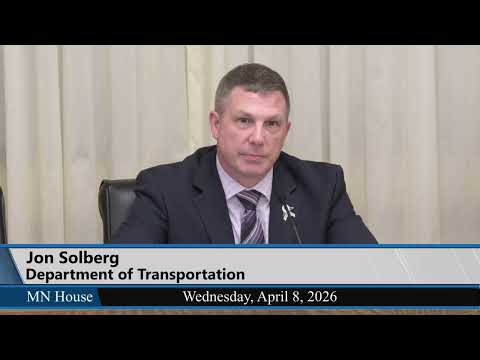
MnDOT officials told the House Transportation Finance and Policy Committee on April 8 that Minnesota’s transportation greenhouse‑gas assessment law is in place for individual projects and that a portfolio assessment is scheduled to begin Aug. 1, 2027, affecting projects in the 2031 program.
"As of Jan. 1, 2025, offsets that have been constructed or contracted are eligible," said John Silver, assistant commissioner for Sustainability Planning and Program Management at the Minnesota Department of Transportation. He described the assessment as a three‑step process: screening projects for applicability (major projects, new interchanges or added lanes over 2,500 feet), estimating the additional vehicle miles traveled (VMT) caused by added capacity, and calculating emissions using the EPA MOVES tool and Minnesota vehicle‑mix assumptions.
The department presented an illustrative Highway 23 (Willmar) scenario showing how VMT and offset options — including transit expansion, land‑use density changes and parking management — are modeled. "The assessment currently on the individual projects is on the additional capacity," Silver said, clarifying that MnDOT looks at the emissions attributable to added vehicle miles rather than the entire existing roadway volume.
County and city officials urged caution. "Before this project can even enter this step, it must complete a full GHG and VMT impact assessment and have a fully funded offset plan in place," said Karla Big, Washington County commissioner, describing a planned grade‑separated interchange at Trunk Highway 36 and Century Avenue that she said could require offsets equal to about 11,000 metric tons of CO2 over 20 years and add an estimated $10–20 million in project cost.
Anoka County Commissioner Julie Jepsen Diamond told the committee a major safety corridor project on Trunk Highway 65 — funded from 17 sources and estimated at roughly $180 million — could have seen offset-related added costs of $30 million to $100 million in MnDOT examples, threatening on‑time delivery of life‑safety improvements. "We support reducing greenhouse gases," she said, "but the law as written is simply not workable for many local partners unless there are clearer funding or implementation mechanisms."
Municipal engineers and TAC members also raised practical concerns about offset accounting, ownership and enforceability. Mark Hulbert, Brooklyn Park public works director and TAC representative, proposed two near‑term changes he said would reduce implementation friction: exempting projects that exceed a critical crash‑rate threshold from mitigation requirements, and automatically counting certain implemented transit, major trail, EV charging or documented land‑use changes as portfolio offsets to reduce disputes over ownership.
Committee members asked technical questions about methods and scope. MnDOT said its tools incorporate projected vehicle fleet changes including electrification, and that some offset activities will not be eligible for trunk‑highway funds if they do not meet legislatively defined highway purposes. MnDOT also warned that portfolio timing must align with project development windows (January–March) to allow projects to enter a federal funding cycle; missing those windows could exclude projects from a given program year.
MnDOT emphasized statewide scale: "The total transportation emissions in the state of Minnesota are about 36 million metric tons," Silver said, noting that individual project offsets are a small piece of the broader emissions picture and that portfolio approaches are intended to address system‑level effects.
The committee did not take formal votes on policy changes during the hearing. Lawmakers and county officials left the session divided on tradeoffs: proponents of the law urged rethinking project design and planning to meet climate goals, while many local officials urged clearer funding rules, targeted exemptions or statutory fixes to prevent safety projects from being delayed or scaled back.
The committee will receive additional technical input as MnDOT and the Technical Advisory Committee refine portfolio definitions, offset accounting methods and guidance for local partners.