Get Full Government Meeting Transcripts, Videos, & Alerts Forever!
Get email alerts on the Family Policy topic
No spam. Unsubscribe anytime.
Committee hears bill to require infertility coverage; members press for fiscal clarity and safeguards
Summary
The House Health Finance and Policy Committee heard House File 4609, the Minnesota Building Families Act, which would require insurers to cover infertility diagnosis and treatments including IVF; patients and clinicians urged passage while faith‑based groups raised ethical objections. Members asked for a fiscal note and laid the bill over for possible omnibus inclusion.
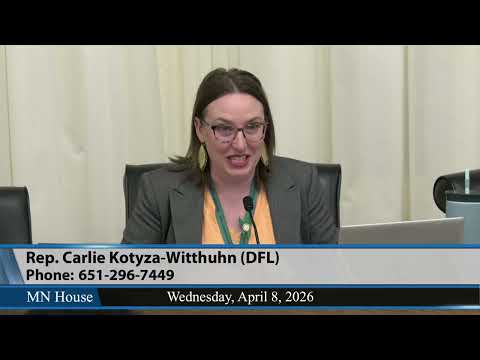
The House Health Finance and Policy Committee on April 8 heard testimony on House File 4609, the Minnesota Building Families Act, a proposal from Representative Kotyza‑witthuhn that would require health insurers to cover infertility diagnosis and treatment, including in vitro fertilization (IVF). The bill was laid over for possible inclusion in an omnibus bill while members seek more fiscal and policy detail.
Supporters, including patients and clinicians, said the mandate would remove a major financial barrier to family building. "In Minnesota, one in 6 experience infertility, more than 186,000 people," patient advocate Brian Graham told the committee, describing families who exhaust savings and take on debt to afford care. Cancer‑survivor Jennifer Stein said she and her husband paid for fertility preservation and IVF out of pocket to have a child, adding, "No cancer survivor should have to fundraise to build a family." Dr. Chandra Tosh (self‑identified as an OBGYN and reproductive endocrinologist at Mayo Clinic) framed infertility as a medical condition and said insurance coverage enables safer clinical practices, such as single‑embryo transfer, that reduce high‑risk pregnancies and NICU stays.
Opponents, including the Minnesota Catholic Conference and Minnesota Family Council, raised ethical and statutory concerns. Maggie Hang (assistant director for family policy, Minnesota Catholic Conference) argued the bill could encourage practices she described as ethically problematic and warned of embryo loss and "commodification" associated with some assisted reproductive technologies. Rebecca Delahunt of the Minnesota Family Council said the bill's third‑party language could be interpreted to require coverage of surrogacy and that state law currently lacks statutory protections for surrogate arrangements.
Members focused questions on two practical issues: scope and cost. Representative Kotyza‑witthuhn said the bill would cover diagnosis and treatment and includes a limit of up to four IVF cycles for an individual, and she emphasized the bill is not intended to change Minnesota's legal framework for surrogacy. On cost, members noted there was not a fiscal note on the version before the committee; witnesses and members cited a range of estimates. A committee reference of public‑program costs put a figure near $8.6 million per biennium, and other actuarial ranges discussed during the hearing ranged from roughly $5 million to $18 million depending on assumptions and whether public programs were included.
Several lawmakers said they support assisting families but want protections and clearer fiscal accounting before advancing a mandate. Representative Bell, among others, said she supports IVF but urged "appropriate guardrails" to protect women and children and to prevent exploitation. Representative Liebling and others urged the committee to treat funding questions as fiscal note issues and to determine whether state reimbursement would offset premium impacts.
The committee renewed a motion to lay House File 4609 over for possible inclusion in an omnibus bill; no final vote on the policy was taken. Committee members asked the sponsor and staff to supply updated actuarial analysis, current CDC clinic success statistics, and a fiscal note to clarify projected costs to public programs and the general fund.
What happens next: The bill was laid over for possible omnibus consideration; members said they expect further conversations on coverage limits, storage guidelines for embryos and the fiscal note before any committee action.