Get Full Government Meeting Transcripts, Videos, & Alerts Forever!
Get email alerts on the Healthcare Fraud Kickbacks topic
No spam. Unsubscribe anytime.
Audit: DHS Could Have Used Existing Authority on EIDBI Kickbacks; Legislature, Agency Discuss Fix
Summary
A Legislative Auditor special review found DHS OIG generally handled complaints but that an incorrect rule citation limited DHS’s ability to act on allegations of kickbacks alone; auditors urged a rule correction or a statutory fix and DHS outlined enforcement steps taken and plans for statutory or rule changes.
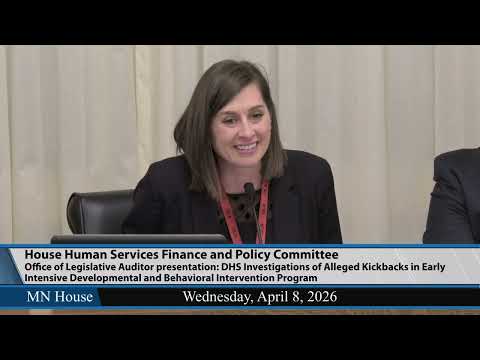
A legislative audit released to the House Human Services Policy and Finance Committee found the Minnesota Department of Human Services (DHS) could have used existing legal authority to address allegations of kickbacks in the Early Intensive Developmental and Behavioral Intervention (EIDBI) program, but a decades-old rule citation left uncertainty over whether DHS could suspend payments during investigations.
Deputy Legislative Auditor Catherine Tyson told the committee the Office of the Legislative Auditor (OLA) reviewed complaints and DHS OIG decisions and “concluded through this review that most of the decisions of OIG that we reviewed [were] reasonable given the information OIG collected or analyzed.” She said, however, that the OLA identified three complaints that alleged only kickbacks and were closed without further investigation and that the department “did not have the authority to investigate allegations of kickbacks” only, a view OLA disputed.
Why it matters: EIDBI is a state Medicaid benefit that reimburses providers for services to children and youth with autism-spectrum and related conditions; the OLA said roughly 5,600 individuals received EIDBI services in 2024. Kickbacks in public-health programs can increase costs and risk unnecessary care, and the OLA recommended clarifying whether DHS may withhold payments during an investigation of kickback-only allegations.
What the audit found and recommended
Tyson explained that an administrative-rule error — an incorrect citation to a federal statute dating to mid-1990s rulemaking — narrowed DHS’s rule definition of fraud and may have prevented the department from treating kickbacks alone as a basis to withhold payments without prior notice. She said the 2025 Legislature later criminalized kickbacks in state public-health programs and added explicit sanction authority, but the OLA concluded that DHS could have used existing authority tied to federal Social Security Act exclusion grounds even before 2025 if it had corrected the rule.
“The error is an incorrect citation to federal law,” Tyson said. “If DHS had corrected the rule at any time since 1995, that would have been another avenue of clear authority to sanction providers who engage in kickbacks.” She recommended that DHS amend its administrative rule to explicitly include kickbacks in the fraud definition; if DHS has not initiated rulemaking, OLA said the Legislature should act.
DHS response and enforcement steps
Commissioner Shireen Gunn, head of DHS, said the department has taken multiple enforcement steps over the past 18 months and welcomed the audit’s findings. “DHS has done extensive work over the last year and a half to increase oversight of this essential service,” Gunn told committee members, noting that DHS staff have made 444 on-site visits to EIDBI providers, opened 63 investigations, referred 20 providers to law enforcement and imposed 22 administrative sanctions, including monetary recoveries, suspensions and terminations.
Gunn said DHS prefers a statutory fix but will pursue rulemaking if the Legislature does not act this session. “We agree with the auditor that the definition of fraud should be made more clear to include kickbacks,” she said, adding that the governor’s proposal and several legislators’ bills this session aim to address the gap.
Questions from lawmakers
Committee members pressed auditors and DHS on several points: how often OLA receives allegations (Tyson said OLA got over 760 allegations last year and completes roughly four major special reviews annually), whether whistleblowers face retaliation (Tyson said she was not aware of retaliation in this review and described confidentiality protections), why a 2025 moratorium on new provider enrollment took months to implement (DHS staff cited steps such as federal CMS approvals and access-to-care reviews), and how DHS monitors rapid enrollment growth seen from 2020 to 2024.
Representative Backer summarized lawmakers’ frustration about taxpayer risk: “When we see this, taxpayers expect someone should have stopped it,” he said, pressing DHS leadership on improving oversight and culture.
Next steps
The OLA recommended that DHS correct its administrative rule to clearly include kickbacks in the fraud definition and, if DHS has not started rulemaking, urged legislative action. DHS said it will continue expanded oversight, finish its reviews of past kickback reports across Medicaid services and pursue legislative or rulemaking remedies to clarify authority to suspend payments during investigations.
The committee did not take a formal vote on the recommendations during the hearing; members and agency leaders signaled interest in moving statutory language and ensuring any state law aligns with relevant federal exceptions.
Ending note
The hearing concluded with DHS committing to continued enforcement and collaboration with the Legislature; committee members said they expected follow-up as the Legislature considers bills this session to make the authority explicit.