Get Full Government Meeting Transcripts, Videos, & Alerts Forever!
Get email alerts on the Consumer Protection topic
No spam. Unsubscribe anytime.
Minnesota Senate passes ban on cryptocurrency kiosks after heated debate
Summary
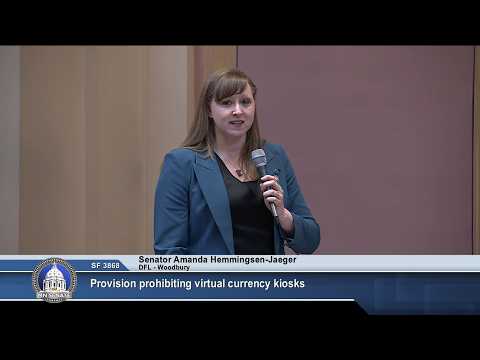
The Minnesota Senate approved Senate File 3868 on April 9, 2026, to ban virtual-currency kiosks statewide, 57–10, after extended debate over amendments, small-business impacts and anti-fraud measures. Sponsor Sen. Hemmingsen-Jaeger said the bill targets scams preying on seniors.
ST. PAUL — The Minnesota Senate passed Senate File 3868 on April 9, 2026, banning virtual-currency kiosks in the state after a lengthy and often contentious floor debate over competing approaches to stopping fraud.
Sen. Hemmingsen-Jaeger, the bill’s sponsor, told colleagues the machines operate “very similar to ATMs” but enable cash to be converted into cryptocurrency that “becomes untraceable,” and said cities and law enforcement had reported seniors were being scammed out of thousands of dollars. “These fraud machines have no place preying on our seniors and Minnesotans,” she said.
The bill prompted multiple amendment offers. Sen. Drazkowski proposed an A2 amendment that would require verification of lawful presence for foreign remittance transfers; the chair sustained a point of order that the amendment was not germane and the ruling was upheld on appeal, 34–33. Drazkowski framed his proposal as a way to “create a firewall to prevent the resources of the people of Minnesota from leaving our state,” language used on the floor as a policy rationale.
Sen. Holmstrom’s A3 amendment — which would have prohibited single transfers of more than $10,000 through Minnesota airports — was also argued as a fraud-prevention measure but did not survive procedural challenges. Sen. Lieske offered an A4 amendment to limit kiosks to withdrawals (not permitting cash inputs), arguing that would curb scams while preserving small-business owners’ investments; that amendment failed 33–34.
Supporters cited law-enforcement letters and group endorsements on senators’ desks, including materials from AARP, and referenced national and state data discussed on the floor. The sponsor cited an FBI figure that “Americans have lost $240 million in crypto-related scams in the first six months of 2025,” and an estimate from the Minnesota Department of Commerce that “losses of nearly $1 million between 2023 and 2025, with $540,000 in 2025.” Those figures were presented by the sponsor as part of the case for a ban.
Opponents and some amendment proponents warned the blanket prohibition would harm small businesses that operate kiosks, calling the measure a “sledgehammer” that would destroy investments. Sen. Lieske said her narrower amendment was “an elegant way to stop the fraud and yet support those small businesses.” Other senators urged further committee work to examine technical options.
On final passage the Senate recorded 57 yeas and 10 nays. The bill’s title was agreed to and the measure was sent on in the legislative process. The Senate recessed to the call of the President after the vote.
Votes and next steps: the Senate approved the bill on final passage, 57–10; the bill title was agreed to and the measure will proceed according to legislative processing rules.