Get Full Government Meeting Transcripts, Videos, & Alerts Forever!
Get email alerts on the State Tax Policy topic
No spam. Unsubscribe anytime.
Senate taxes committee hears Department of Revenue policy-and-technical bill, including background-check change for legislative auditors
Summary
The Minnesota Senate Taxes Committee on April 9, 2026 heard the Department of Revenue's policy-and-technical bill (SF 4690). Department witnesses described statutory cleanups, a composite-return change for installment sales, JOBZ cleanup, and an amendment to add Legislative Auditor staff to a federal-TPI background-check/fingerprinting requirement beginning in 2026; SF 4690 was laid over for further consideration.
The Minnesota Senate Taxes Committee heard testimony April 9 on Senate File 4690, the Department of Revenue's annual policy-and-technical bill, which includes statutory cleanups, a corporate/income tax change, and an amendment to add Legislative Auditor staff to a federal taxpayer-information background-check requirement.
Joanna Bayers, legislative director for the Department of Revenue, told the committee the bill is "small but it provides meaningful prudence for taxpayers," emphasizing statutory housekeeping, administrative efficiency and removal of obsolete language. She said an amendment added the previous day would ensure the Office of Legislative Auditor's staff can meet federal requirements for access to federal taxpayer information by undergoing the national criminal-history background check and associated fingerprinting beginning in 2026.
Why it matters: adding the Legislative Auditor's staff to the list of individuals required to undergo federal background checks addresses a federal requirement tied to access to federal taxpayer information; committee members asked staff to follow up on the operational details.
Key details of the bill presented to the committee included:
- Composite returns and installment-sales reporting: Steve Syverson, an attorney with the Department of Revenue, said Article 1 would allow partnerships to file composite returns on behalf of nonresident partners who recognize gains on installment sales, with accelerated recognition of gains into the first taxable year after a sale. Syverson said the change concerns reporting and convenience rather than changing the taxpayer's liability: "it is simply that the partnership pays it on behalf of the owner." The amendment would apply to taxable years beginning after Dec. 31, 2025.
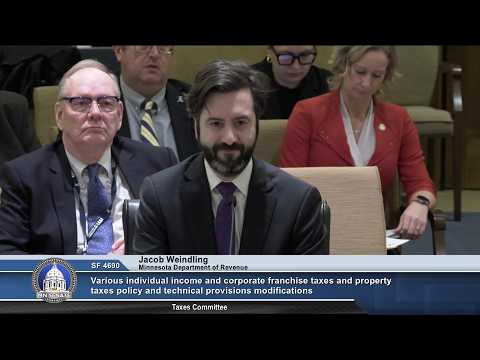
- Property-tax housekeeping: Jacob Weindling summarized Article 2's work removing references to expired valuation exclusions, deleting an expired Green Acres provision, and repealing statutory transmission requirements the commissioner does not use; these provisions would take effect the day following final enactment.
- JOBZ cleanup and agency cross-references: Article 3 updates multiple statutes left after the JOBZ program expired for taxes payable in 2016; the changes affect the departments of revenue, education and employment/economic development and were described as statutory cleanup.
- Miscellaneous corrections: Jim Jordan (Dept. of Revenue) described three additional provisions: allowing prosecutors discretion to consolidate criminal tax prosecutions across counties for all tax types (effective for offenses committed after July 31, 2026); correcting a cross-reference to the volunteer-ambulance attendant definition used in an MNCare exemption; and a change to how the commissioner updates auto-parts sales-tax deposit estimates when law changes after the February forecast (with a retroactive effective date of Jan. 1, 2026).
Committee questions and next steps: Committee members asked for follow-up on why certain local reporting requirements were historically included and why they are no longer needed. The department offered to provide additional information. The committee laid SF 4690 (as amended) over for further consideration; department staff were not asked to secure votes during this hearing.
The committee did not take a final vote on the bill; staff said they would provide requested clarifications to members before further action.