Get Full Government Meeting Transcripts, Videos, & Alerts Forever!
Get email alerts on the Energy Omnibus topic
No spam. Unsubscribe anytime.
Senate energy omnibus outlined; committee adopts technical amendments, funds energy assistance and RDA projects, and pauses after contentious data-center and n
Summary
The Senate Energy Committee walked through Senate File 4504, adopted multiple technical amendments, approved funding priorities including $15M for energy assistance and RDA project allocations, debated data-center host-community carve-outs and a nuclear-study amendment, and laid the omnibus over for further negotiation.
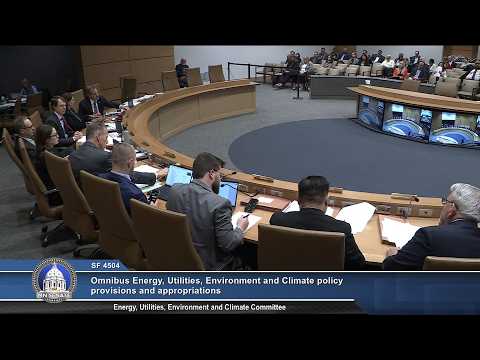
The Senate Energy, Utilities, Environment and Climate Committee on April 8 advanced a detailed walk-through of the Senate energy and finance omnibus (Senate File 4504), adopted several technical and programmatic amendments, and paused further action after contentious debate over data-center host-community provisions and expanded nuclear-study language.
Committee staff reviewed Article 1 and the fiscal portions. Mr. Miro Mueller described appropriations including a $40,000 thermal energy networks appropriation (FY27 recaptured via assessment), $15 million for energy-system grants, and a suite of Renewable Development Account line items totaling roughly $40 million. The RDA list included one-time and multi-project allocations — for example, $100,000 to the University of St. Thomas for a crude project, $3.5 million for a green-hydrogen project in St. Cloud, $750,115 identified for a biomass-energy facility study (the Becker/Liberty Paper item), multiple geothermal and university research appropriations, and $3 million for PCA biomass generation in Shakopee.
P. Wyckoff, deputy commissioner of energy resources at the Minnesota Department of Commerce, said the department supports many provisions and confirmed it is prepared to administer new studies and programs if the committee adopts them, but asked for a technical fix related to the electric school-bus deployment language.
City and project representatives described local projects: Tracy Holte of St. Cloud said the city has reached 90% design on a green-hydrogen project and needs a $3.5 million battery-system appropriation to commission equipment waiting on a steady power supply. Willie Rar, a biomass applicant in Shakopee, asked for $3 million to install infrastructure to convert woody waste into thermal energy. Representatives of the Citizens Utility Board and Minnesota Community Action Partnership supported $15 million in energy-assistance funding as an urgent priority; CUB noted Minnesotans are behind on utility bills by about $145 million.
Committee amendment activity included the adoption of technical corrections (A3, A12), program adjustments (A18, which narrowed year-round grant-acceptance language for energy assistance), and policy add-ons such as a plug-in-solar amendment (A16) that passed after debate over safety and net-metering interactions. Senator Robert Matthews offered Amendment A8 to expand data-center host-community exemptions and certificate-of-need carve-outs for Becker and other communities; that amendment produced extended debate and a roll-call defeat (4–5). Senator Matt D. offered A17 to broaden and neutralize a new-nuclear study; the Prairie Island representative said the tribe would be neutral only if four core study elements remained (environment/health impacts, spent-fuel/waste questions, emergency-response preparedness, and community-acceptance safeguards). Following a recess for stakeholder consultation the committee laid the omnibus over to allow further negotiation with House language and affected stakeholders.
Why it matters: the omnibus contains both grant funding that state agencies can administer quickly (energy assistance, geothermal planning grants, RDA projects) and policy provisions that could change how large energy users and data centers are treated in Minnesota law. Several members warned that late changes risked undermining interchamber agreement and could imperil the omnibus in conference.
What’s next: committee leadership said the bill will move to the Finance Committee and to further stakeholder negotiation. Members asked staff to continue working with the Department of Commerce, Prairie Island and other stakeholders to refine study language and administrative details before the Senate votes.