Get Full Government Meeting Transcripts, Videos, & Alerts Forever!
Get email alerts on the Conversion Therapy topic
No spam. Unsubscribe anytime.
Minnesota committee advances two bills to hold conversion-therapy practitioners accountable and limit insurance coverage
Summary
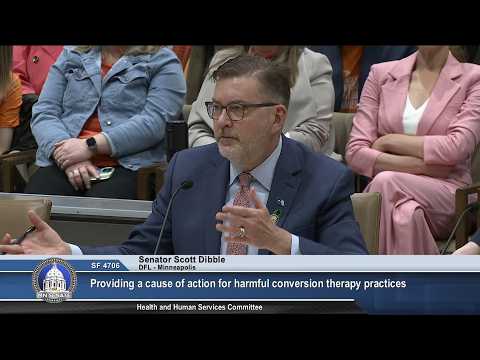
The Senate Health and Human Services, Finance and Policy Committee advanced SF 4706, creating a civil cause of action for minors harmed by conversion therapy, and SF 4707, which would prohibit insurance coverage for such treatments and expand enforcement tools. Supporters described harms and urged accountability; opponents warned of First Amendment and scope concerns.
Senate committee members on April 8 advanced two related bills targeted at conversion therapy, moving SF 4706 — which would give survivors a private civil remedy — and SF 4707 — which would bar insurance coverage and expand human-rights enforcement — to other panels for further review.
Sponsor presentation: Senator Dole, the bill sponsor, told the committee the A2 author’s amendment narrows the proposal to regulate professional conduct, not speech, and builds procedural safeguards to align with the Supreme Court’s recent guidance. “What it does is create a civil cause of action for individuals who are subjected to conversion therapy as minors and suffered harm as a result,” she said, explaining the amendment focuses on treatment that is “directed toward a predetermined outcome” or that uses coercive or nonconsensual techniques.
Survivors and advocates testifying in support said conversion therapy remains active and harmful. Keegan Miller of the Trevor Project told senators that more than one in 10 Minnesota LGBTQ youth have been threatened with or subjected to conversion therapy and that exposed youth are “more than twice as likely to have attempted suicide.” He urged the committee to pass SF 4706 and SF 4707 to provide accountability and a deterrent effect.
Opposition and constitutional questions: Renee Carlson, general counsel for Children’s Legal, and several licensed practitioners said the bills risk restricting protected speech and are vulnerable to constitutional challenges. Carlson described SF 4706 as a “workaround” that could reintroduce the same constitutional infirmities the U.S. Supreme Court identified in its recent decision and warned the legislation’s definitions closely mirror the Colorado law the Court reviewed.
Several senators pressed authors on whether the amended language removes the constitutional concerns. Committee counsel noted the Supreme Court sent the Colorado statute back to a lower court for strict‑scrutiny review rather than declaring it flatly unconstitutional, and authors said the amendment is designed to be viewpoint neutral by centering assessments on whether client goals are independently expressed and free from coercion.
Committee action and next steps: The committee voted to recommend SF 4706, as amended, to pass and referred it to the Judiciary and Public Safety Committee. It also voted to recommend SF 4707 to pass and referred that bill to the Commerce and Consumer Protection Committee. Both referrals will subject the bills to further legal and policy review before any floor action.